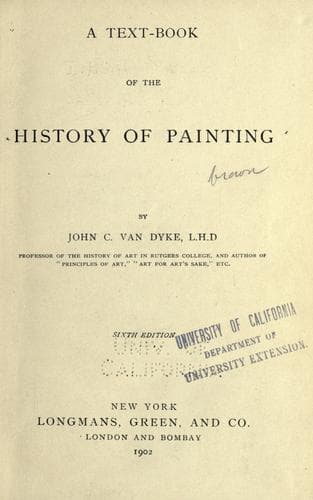
A Text-Book of the History of PaintingVan Dyke, John C.
History
A Text-Book of the History of Painting
Van Dyke, John C.
Painting -- History
The true descent of the Umbrian sentiment was through Foligno and
Bonfiglio to Perugino (1446-1524). Signorelli and Perugino seem
opposed to each other in their art. The first was the forerunner of
Michael Angelo, the second was the master of Raphael; and the
difference between Michael Angelo and Raphael was, in a less varied
degree, the difference between Signorelli and Perugino. The one showed
Florentine line, the other Umbrian sentiment and color. It is in
Perugino that we find the old religious feeling. Fervor, tenderness,
and devotion, with soft eyes, delicate features, and pathetic looks
characterized his art. The figure was slight, graceful, and in pose
sentimentally inclined to one side. The head was almost affectedly
placed on the shoulders, and the round olive face was full of wistful
tenderness. This Perugino type, used in all his paintings, is well
described by Taine as a "body belonging to the Renaissance containing
a soul that belonged to the Middle Ages." The sentiment was more
purely human, however, than in such a painter, for instance, as Fra
Angelico. Religion still held with Perugino and the Umbrians, but
even with them it was becoming materialized by the beauty of the
world about them.
[Illustration: FIG. 31.--PERUGINO. MADONNA, SAINTS, AND ANGELS.
LOUVRE.]
As a technician Perugino was excellent. There was no dramatic fire and
fury about him. The composition was simple, with graceful figures in
repose. The coloring was rich, and there were many brilliant effects
obtained by the use of oils. He was among the first of his school to
use that medium. His friend and fellow-worker, Pinturricchio
(1454-1513), did not use oils, but was a superior man in fresco. In
type and sentiment he was rather like Perugino, in composition a
little extravagant and huddled, in landscape backgrounds quite
original and inventive. He never was a serious rival of Perugino,
though a more varied and interesting painter. Perugino's best pupil,
after Raphael, was Lo Spagna (?-1530?), who followed his master's
style until the High Renaissance, when he became a follower of
Raphael.
Public-domain text, read in full here on John Shaqi.
Reviews
Reviews
No reviews yet
Be the first to share your thoughts on this work.
Join the Discussion
Join the discussion
Sign in to leave a comment or review.
Sign InorCreate an account