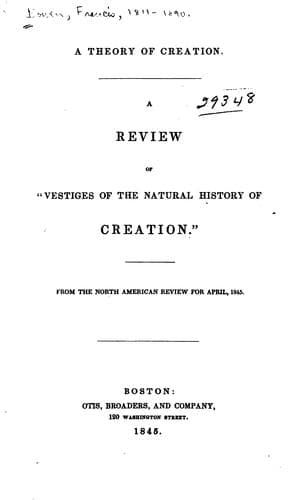
A Theory of Creation: A Review of 'Vestiges of the Natural History of Creation'Bowen, Francis
Religion
A Theory of Creation: A Review of 'Vestiges of the Natural History of Creation'
Bowen, Francis
Chambers, Robert, 1802-1871. Vestiges of the natural history of creation; Creation; Evolution (Biology)
These facts and reasonings, it is true, only go to prove, that
animalcules, or beings of very small size, and low in the scale of
animated existence, can be produced in this way by the inherent
qualities of matter. No one will pretend, that a dog, a horse, or a man
can thus be created. How can we account for the existence of these
larger animals of a higher type, admitted to have been denizens of the
earth only since the latest geological epochs, and therefore of
comparatively recent origin? Here we come to another point in our
author's theory,--the transmutation of species, or the successive
_development_ of higher and higher orders of being out of the species
immediately below them, through the accidental or natural fulfilment of
certain conditions, in the course of a long period of years.
Natural history teaches us, that there is quite a regular gradation
among the several tribes of vegetables and animals; though we may not be
able to range all the species, as constantly advancing in a single line,
there is certainly the general appearance of a scale, beginning with the
most simple, and going on to the most complex forms. While the external
characteristics are very different, all are but variations of a single
plan, which exists as the basis of all, and is varied in each individual
only so as to accommodate it to the conditions under which the
individual is to live. The germ of a higher animal--a mammifer, for
instance--is the representative of a lower animal full-grown, like the
_volvox globator_; the latter remaining in this initial stage, as an
animalcule, through its whole existence; while the former is developed
out of it, by successive stages, into a quadruped, or even into a man.
Similar functions are performed in different animals by very different
organs, the gills of fishes performing the same office as the lungs of
the mammalia; and these different organs sometimes exist, at different
periods, according to the degree of development, in the same animal.
Thus, the tadpole, so long as it continues to be a fish, breathes by
gills, which disappear and give place to lungs when it becomes a frog.
Similar transformations of the insect tribe are familiar to all.
Imperfect or rudimentary organs are found in certain animals, as the
mammae of a man; a particular organ being here developed to a certain
extent, though it is not needed; but being developed a little further,
it becomes useful in the next set of animals in the scale. The same
peculiarity is found among plants; the skilful gardener being able
actually to develope these rudimentary organs by supplying the requisite
conditions, and thus, as it were, to raise the plant one step in the
scale.
Public-domain text, read in full here on John Shaqi.
Reviews
Reviews
No reviews yet
Be the first to share your thoughts on this work.
Join the Discussion
Join the discussion
Sign in to leave a comment or review.
Sign InorCreate an account