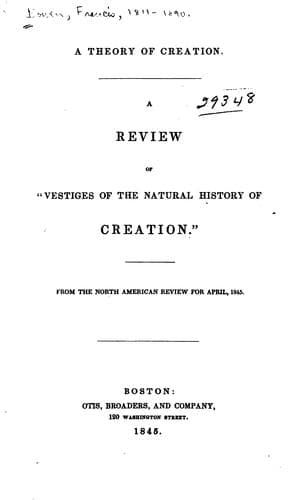
A Theory of Creation: A Review of 'Vestiges of the Natural History of Creation'Bowen, Francis
Religion
A Theory of Creation: A Review of 'Vestiges of the Natural History of Creation'
Bowen, Francis
Chambers, Robert, 1802-1871. Vestiges of the natural history of creation; Creation; Evolution (Biology)
We actually see natural agents now at work around us, producing results
which counterfeit life, if they do not constitute it. Many substances
crystallize into shapes bearing a strong resemblance to vegetable forms,
as in the well known chemical experiment producing the _arbor Dianae_.
The passage of the electric fluid leaves marks that are like the
branches and foliage of a tree, and the same fluid exerts a direct
influence on the germination of plants. Some of the proximate principles
of vegetable and animal bodies, such as urea and alantoin, are said to
have been produced artificially by the chemist; and in the combination
of the simple elements, such as carbon and oxygen, into these proximate
principles, it is now acknowledged that there is no violation of the
ordinary laws of chemical affinity. The origin of all vegetable and
animal life, so far as it can be traced, is in germinal vesicles, or
little cells containing granules. Such are the ova of all animals; and
both vegetable and animal tissues are entirely formed from them. When
the parent cells come to maturity, they burst and liberate the granules,
which immediately develope themselves into new cells, thus repeating the
life of their original. Now, it has been asserted, that globules can be
produced in albumen by electricity; and _if these globules are true
germinal vesicles_, the difficult problem of producing life by
artificial means is entirely solved.
But the burden of this part of the theory rests on the evidence that has
been produced of late years to favor the doctrine of equivocal
generation, or the production of living beings without the agency,
either direct or indirect, of parents of the same species. Can such
beings, _orphans_ in the strictest sense, now be produced or discovered?
We have not space to repeat our author's argument on this difficult
mooted question in science, nor is it necessary; he sums up the evidence
on his own side, and of course finds it satisfactory, though the weight
of authority is against him. He adduces the experiments of Mr. Crosse,
repeated by Mr. Weekes, who claim to have produced animalcules in
considerable numbers, of a species before unknown, by passing a voltaic
current through silicate of potash, and through nitrate of copper. The
existence of _entozoa_, or parasitic animals, found in the interior of
the bodies of other animals, and found nowhere else, is thought to
support the same doctrine. The question is, How came they there? Being
too large, either in their perfect form, or in the egg, to have passed
through the capillary blood-vessels, how came they within the body of
another animal,--itself but a few weeks or a few days old, or even in
the embryo stage,--unless they were created there without parentage of
their own species?
Public-domain text, read in full here on John Shaqi.
Reviews
Reviews
No reviews yet
Be the first to share your thoughts on this work.
Join the Discussion
Join the discussion
Sign in to leave a comment or review.
Sign InorCreate an account