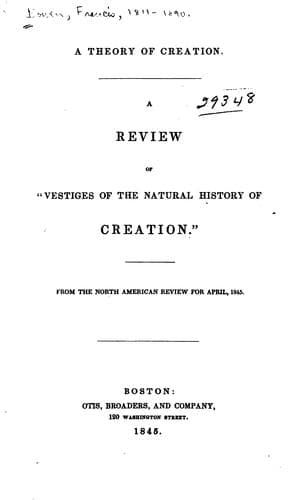
A Theory of Creation: A Review of 'Vestiges of the Natural History of Creation'Bowen, Francis
Religion
A Theory of Creation: A Review of 'Vestiges of the Natural History of Creation'
Bowen, Francis
Chambers, Robert, 1802-1871. Vestiges of the natural history of creation; Creation; Evolution (Biology)
This may be made more clear by examples. If a child, who has had little
experience of the laws of nature, and has learned nothing from books, is
gravely assured by his instructor, that in a distant region of the ocean
there is an island where stones fly upward instead of downward, and men
walk on their heads instead of their feet, the young philosopher,
however acute and ingenious we may suppose him to be, certainly could
not offer one valid argument against the alleged fact. He could only
stare, and wonder, and say that it might be so _for all that he knew to
the contrary_. Just so, when the atheist tells us, that far off in
infinite space is a region, of which we can see nothing, even with our
best telescopes, except a faint glimmer of light, floating like a
cloudlet in the heavens, where the primitive atoms of matter, directed
by gravity alone, are slowly congregating together, and forming suns,
and planets, and secondary satellites, and giving birth to such
intricate harmonies of mutually dependent and revolving worlds as those
which have prevailed for ages in our own system; or that, thousands of
years ago, the same unassisted laws of matter, which we now see
producing only such comparatively meagre and insufficient results,
actually caused animalcules to be produced from pure sand, and fishes to
be created out of oysters, and birds to be generated by slimy and
grovelling reptiles, and men to be born from monkeys;--if he should tell
us all this, certainly we could offer no direct confutation of the
wonderful tale. In regard to alleged facts of this character, the wisest
of men are, and always must be, mere children. But it would be monstrous
to say, that this wild assertion derived any support from their admitted
bewilderment and incapacity. This would be to attempt to found knowledge
upon ignorance. The dim analogies resting on questionable facts, the
bold assumptions and slippery arguments on which such daring hypotheses
must be based, can be refuted, for the most part, only by reasoning in
kind,--by arguments nearly as uncertain, it may be, as those which they
are brought to answer. We cannot _prove_ a negative; we can only show
the insufficiency of the ground on which the opposite assumption is made
to rest; and enough is done for this end, when it is made to appear,
that the whole scheme is a _mere_ hypothesis.
Public-domain text, read in full here on John Shaqi.
Reviews
Reviews
No reviews yet
Be the first to share your thoughts on this work.
Join the Discussion
Join the discussion
Sign in to leave a comment or review.
Sign InorCreate an account