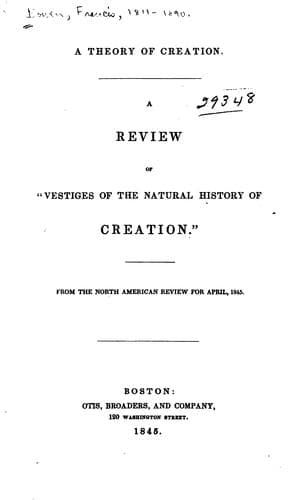
A Theory of Creation: A Review of 'Vestiges of the Natural History of Creation'Bowen, Francis
Religion
A Theory of Creation: A Review of 'Vestiges of the Natural History of Creation'
Bowen, Francis
Chambers, Robert, 1802-1871. Vestiges of the natural history of creation; Creation; Evolution (Biology)
We make these general remarks only to relieve some readers of this
volume from the doubt and perplexity which its perusal may have caused,
solely because they were unable to detect any one glaring fallacy or
inconsistency in the writer's theory. It appears plausible enough; for,
though there is very little in its favor, it seems at first sight as if
there was little or nothing to say against it. On closer scrutiny, it
will be found, perhaps, that it is disproved by a multitude of
considerations, any one of which would be fatal to it; as the hypothesis
is of such a character, that, when a single breach is made in it, the
whole edifice must tumble. If the intervention of an extraneous cause be
absolutely necessary at any one stage or process in the creation, it may
as well be admitted in all; the principle must be given up, and the
whole purpose of the theist is answered. We shall endeavour to show that
this hypothetical history of creation is not only faulty in every point,
when viewed from the author's own ground, but, when examined in the
proper direction, is absolutely unintelligible, or is in fact no history
at all.
Let us look first at the nebular hypothesis. Certain spots and tracts in
the heavens, of a whitish color, appearing to the naked eye to be
nebulae, on being examined through a telescope, instantly resolve
themselves into a multitude of distinct and perfectly formed stars. Such
is the greatest nebula of all,--the galaxy, or milky way. Other spots of
a like character, if viewed through glasses of moderate power, still
appear as nebulae; but when seen through more perfect instruments, they
immediately seem, like the others, to be a mere crowd of stars. Others,
again, are not separated or resolved by the best telescopes; but what is
the natural inference from this fact? Surely, we infer that they are
merely crowded collections of stars, just like the others, except that
they are too distant or too small to be seen as distinct bodies, even
with the most powerful instruments that we possess. If telescopes of a
greater range should hereafter be constructed, there is every reason to
believe that these also will be resolved to the eye into their component
parts as stars; and in fact, if newspaper accounts may be credited, when
Lord Rosse's new and magnificent telescope was first turned towards some
of these spots, which had always preserved their nebulous appearance
when examined by inferior instruments, it was immediately apparent, that
they were composed of distinct stars. Yet the hypothesis we are now
considering assumes, that these remote and faintly seen nebulae are not
crowds of stars, but primitive luminous matter, the particles of which
are slowly congregating together, and forming one new star, or several.
Certainly, never was a bold theory built upon a narrower basis. It is
due, however, to the two Herschels, the chief supporters of this theory,
to say, that they have always spoken of it only as a hypothesis, and by
Public-domain text, read in full here on John Shaqi.
Reviews
Reviews
No reviews yet
Be the first to share your thoughts on this work.
Join the Discussion
Join the discussion
Sign in to leave a comment or review.
Sign InorCreate an account