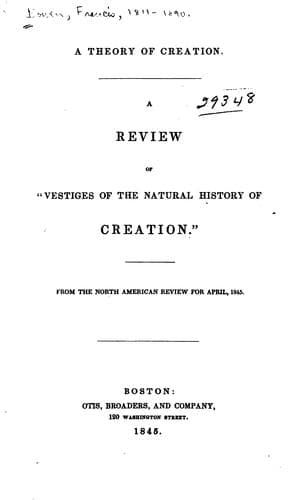
A Theory of Creation: A Review of 'Vestiges of the Natural History of Creation' — John Shaqi
A Theory of Creation: A Review of 'Vestiges of the Natural History of Creation'Bowen, Francis
Religion
A Theory of Creation: A Review of 'Vestiges of the Natural History of Creation'
Bowen, Francis
Chambers, Robert, 1802-1871. Vestiges of the natural history of creation; Creation; Evolution (Biology)
If the matter now concentrated in the sun, and that which forms the
several planets with their secondaries, were all moulded into one mass,
and then dilated so as to fill the vast sphere of which the orbit of
Uranus forms a circumference, the substance would evidently be in a
state of extreme tenuity and diffusion. Immense as the mass of the sun
now is, it is but a mere nut at the centre of the grand globe which we
are now considering. Expanded to such vast dimensions, we cannot
conceive of it as a solid spheroid turning upon its axis, but only as a
mass of fluid or vapor, in which a circular motion would generate only
vortices or whirlwinds. In such an aggregation of subtile matter, no
crust could be solidified on the outer ring, and then detached from the
mass within; indeed, any separation of the parts under such
circumstances is inconceivable. Even a rotary motion could not be
established in it, except by an impulse received from without; for there
is every reason to believe, that the movement of a homogeneous fluid
towards its centre, if it could take place without disturbing causes,
would be in radial lines, and not in a spiral.
Our author brings into view all the mathematical proportions and uniform
relations which exist between the constituent bodies of the solar
system, in order to indicate the probability of their formation from the
constant working of one material cause. Thus he remarks, that the
primary planets all move nearly in one plane, and "show a progressive
increase of bulk and diminution of density, from the one nearest to the
sun to that which is most distant." But he passes over other
characteristics of these bodies, equally important, which are quite
irregular, and cannot be traced to the operation of one law. Compare the
periods of rotation on their respective axes, and we find no
correspondence, no indication that the revolving motion was imparted to
all by one inflexible law. The first four planets, counting from the
sun, perform their rotation in nearly the same time, namely, twenty-four
hours. But Jupiter's period is a little less, and Saturn's a little
more, than ten hours. Again, Jupiter's axis of rotation is nearly
perpendicular to the plane of the ecliptic, while that of Mars is
inclined at an angle of fifty-nine degrees forty-two minutes. Another
irregularity, still more fatal to the theory, is found in the number of
satellites by which the respective planets are attended. Saturn has
seven, beside the two rings; Jupiter has four, Mars has none, and the
earth has but one. On the single hypothesis, that our system was formed
by rings successively thrown off from a central body by a process of
refrigeration and contraction, these irregularities are inexplicable.
Mars, it seems, did not shrink at all, while Jupiter cast off four
separate rings, and the earth produced its single moon. The distances of
these bodies from their primaries are also quite irregular; in the case
Public-domain text, read in full here on John Shaqi.
Reviews
Reviews
No reviews yet
Be the first to share your thoughts on this work.
Join the Discussion
Join the discussion
Sign in to leave a comment or review.
Sign InorCreate an account