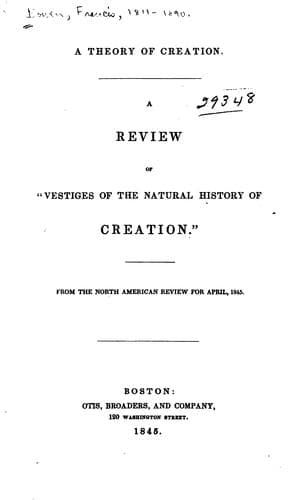
A Theory of Creation: A Review of 'Vestiges of the Natural History of Creation'Bowen, Francis
Religion
A Theory of Creation: A Review of 'Vestiges of the Natural History of Creation'
Bowen, Francis
Chambers, Robert, 1802-1871. Vestiges of the natural history of creation; Creation; Evolution (Biology)
"Credat Judaeus Apella;
Non ego."
We pass to the next chapter in the history, which professes to explain
the gradual formation of a solar system by a process of cooling and
shrinking, to which the central orb is exposed. And here we are met by a
difficulty at the outset; for the existence of comets with their very
eccentric orbits is wholly irreconcilable with the theory. At their
perihelion, many of these bodies pass within the orbit of Mercury, while
the aphelion of some lies without the path of Uranus. Where were they,
when the body of the sun filled up the whole of the vast sphere
circumscribed by the orbit of the remotest planet? If we suppose that
they are late comers, after the rest of our system was perfected,--that
they were generated by themselves in distant regions of space, and,
having strayed about, orphan-like, for a while, they accidentally
crossed our track, and were taken as adopted children into our family,
another question remains to be answered. Why did they not remain in
their first position, absorb their full share of nebulous matter, beget
a respectable family of planets, and take rank as chiefs of their own
clan? These comparatively anomalous bodies are great stumbling-blocks
for the _soi-disant_ historians of creation.
Again, if an immense orb be formed, the parts of which cohere strongly
enough for the whole to turn upon its axis as one body, the process of
cooling can go on only from the surface. A crust may finally be formed
there; but we see not how the refrigeration and shrinking of the
interior parts can then go on separately, until the mass in the centre
finally becomes detached from its envelope, like a shrivelled nut from
its shell. Our earth is cooling down at this moment, unless the warmth
which it receives from the sun exactly counterbalances the loss by
radiation of internal heat. But the exterior and interior do not cool by
different radiations, nor is there, so far as we know, the least
tendency in the central mass to shrink separately, so as to detach
itself from the surrounding crust. As deep as we can penetrate towards
the centre, we find the heat regularly increase,--just as we might
expect, if the only absolute loss of heat be from the surface.
Public-domain text, read in full here on John Shaqi.
Reviews
Reviews
No reviews yet
Be the first to share your thoughts on this work.
Join the Discussion
Join the discussion
Sign in to leave a comment or review.
Sign InorCreate an account