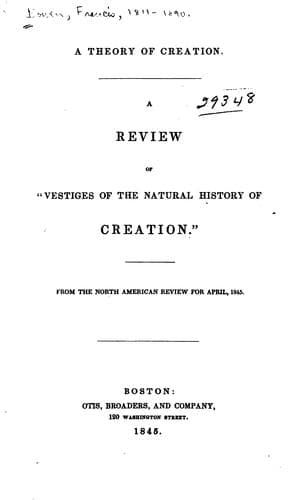
A Theory of Creation: A Review of 'Vestiges of the Natural History of Creation' — John Shaqi
A Theory of Creation: A Review of 'Vestiges of the Natural History of Creation'Bowen, Francis
Religion
A Theory of Creation: A Review of 'Vestiges of the Natural History of Creation'
Bowen, Francis
Chambers, Robert, 1802-1871. Vestiges of the natural history of creation; Creation; Evolution (Biology)
We are not attempting to impugn the credit of geological science in
general, which would be a wholly futile task. The multitude of facts
respecting the present constitution of the earth's crust, recently made
known by laborers in this department, are among the most curious and
most pregnant discoveries of modern times. But when we come to the
formation of theories respecting the past history of the earth, in order
to account for the phenomena at present visible on its surface, we are
evidently afloat on a sea of conjecture, each hypothesis being valid
only till a more plausible one is proposed,--which happens very
frequently,--or till it is effectually disproved by some new discovery
in the rocky strata. A fertile imagination and a bold face are among the
most striking traits of our more daring geologists. Grant to one of this
character a few modest postulates,--give him certain millions of years,
a sufficient number of earthquakes, a whole battery of volcanoes, a few
ocean deluges, and the rise and fall of half a dozen continents,--and he
will frame a theory off-hand, which will account for the most perplexing
phenomena. Our author is certainly entitled to take his place at the
very head of this class of speculatists.
In accounting for the work of creation by the natural and unassisted
development of the inherent qualities of brute matter, the great
difficulty is found at the first link in the chain of animated being.
How can we explain the commencement of _life_? We must have a clear idea
of the whole scope of this problem, before we can make any attempt at
its solution. Life, then, is _not_ mere organization, though most
materialists, philosophers, like our author, willingly confound the two
things; to hear them reason, one would almost suppose that there was no
difference between a dead man and a living one. Organization is
subservient to life, ministers to it, manifests it,--supports it, if you
please,--but does not constitute it. He must be a bolder man than we
are, who will undertake to say _what it is_; but we can very safely
declare _what it is not_; and in any particular form or aggregation of
matter, whether organic or inorganic, we can give a shrewd guess as to
its presence or absence. It may be said, that we beg the question by
assuming that organization is not life; it may be so; but it is quite
too much to allow the materialist quietly to take the opposite doctrine
for granted. He must know the full extent of his task,--that it is
necessary for him not only to construct the machine, but actually to set
it in motion, so that it shall afterwards run on of its own accord. It
is very easy to frame a partial definition of life, by merely describing
one or two of its characteristic functions; and then, because some
action can be detected between the particles of brute matter, which
resembles the exercise of these functions, boldly to declare that the
whole mystery is solved. Thus it is said, that life is nothing but the
Public-domain text, read in full here on John Shaqi.
Reviews
Reviews
No reviews yet
Be the first to share your thoughts on this work.
Join the Discussion
Join the discussion
Sign in to leave a comment or review.
Sign InorCreate an account