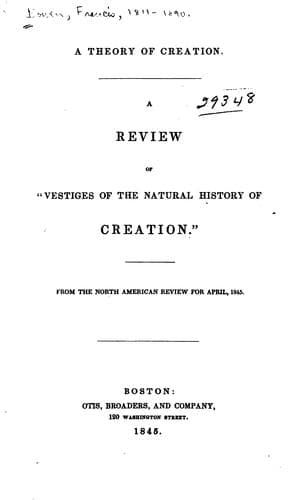
A Theory of Creation: A Review of 'Vestiges of the Natural History of Creation'Bowen, Francis
Religion
A Theory of Creation: A Review of 'Vestiges of the Natural History of Creation'
Bowen, Francis
Chambers, Robert, 1802-1871. Vestiges of the natural history of creation; Creation; Evolution (Biology)
accretion of similar substances, or the addition of like unto like; and
as this occurs in crystallization, which is confessedly a phenomenon of
inorganic matter, therefore there is no fundamental difference between
the properties of living and dead substances. We deny the first
proposition; nutrition is not the only characteristic of life, and the
nutritive process, whether in vegetables or animals, is not mere
accretion, but assimilation. It has been said, though the assertion is
by no means fully proved, that assimilation is only a finer kind of
chemistry, the constituent principles being brought together only by
their natural affinities. Even if this were true, if the stomach and the
digestive apparatus were only a well furnished chemical laboratory, fit
for conducting the most delicate experiments, the great difficulty would
still remain. The question might yet be asked, Where is the chemist? And
this is the fundamental question, which the materialists never attempt
to answer, but quietly evade.
The difference between an inorganic and an organic body has been
explained by Coleridge clearly enough for our purpose. In the former,--a
sheaf of corn, for instance,--the whole is nothing more than a
collection of the individual parts; in the latter,--an animal,--the
whole is the effect of, or results from, the parts. In the latter case,
the whole is every thing, and the parts are comparatively nothing. One
of the great effects of life is to keep the parts in subjection to the
whole, making them contribute to its support and growth, and thus
maintaining the unity of the system. The stomach digests, the lungs
inhale air, the heart beats, and the blood circulates; and as the joint
effect, or as the common supporter,--it matters not which,--of these
operations, _life_ continues, and the animated being is a unit; it has
not merely virtual, but essential unity. The reciprocal action of the
respiratory, circulating, and nervous systems is absolutely necessary to
life. The animal dies, and this unity, this subservience of the parts to
the whole, immediately ceases. In the functions of the living body, it
may be that the ordinary laws of chemistry are preserved, and that the
elements of carbon, oxygen, and hydrogen combine and separate according
to their ordinary affinities, and in no unusual proportions. But after
death, at any rate, quite a different set of chemical laws come into
play, and produce a result which is the very opposite of that before
effected. There is no longer any unanimity or cooeperation; instead of
sustaining or building up the animal tissues, the affinities now in
operation tear down, destroy, and resolve them into their ultimate
elements,--each part following out its own law of destruction or
resolution, irrespectively of the others.
Public-domain text, read in full here on John Shaqi.
Reviews
Reviews
No reviews yet
Be the first to share your thoughts on this work.
Join the Discussion
Join the discussion
Sign in to leave a comment or review.
Sign InorCreate an account