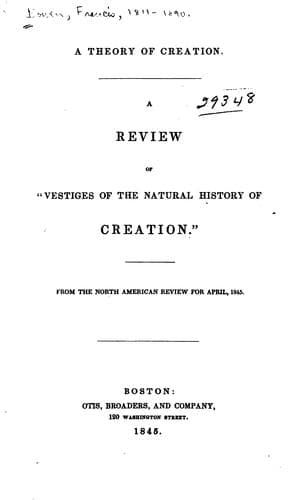
A Theory of Creation: A Review of 'Vestiges of the Natural History of Creation' — John Shaqi
A Theory of Creation: A Review of 'Vestiges of the Natural History of Creation'Bowen, Francis
Religion
A Theory of Creation: A Review of 'Vestiges of the Natural History of Creation'
Bowen, Francis
Chambers, Robert, 1802-1871. Vestiges of the natural history of creation; Creation; Evolution (Biology)
Recent accounts show, that the dust collected from the atmosphere at
sea, many miles from land, generally contains some of these dried
animalcules and their ova. Many of these germs can be developed only in
particular localities, or under certain conditions which are rarely
fulfilled. Consequently, if there were but few of them, the species
might perish, because those few might not find their appropriate home.
But such an accident is guarded against by the vast multiplication of
these germs and their wide dispersion; for, unlike all the higher tribes
of beings except man, the same species is often found in all regions of
the globe. Very few, in comparison with the whole number, may find a
proper _nidus_; but these few then propagate with such marvellous
rapidity, as fully to replenish, if not to increase, the original stock.
Thus they have been enabled, as species, to survive even those
destroying causes which exterminated all the higher forms of animals.
Several species still exist, which were in being at the time of the
cretaceous formation, though all the other animated races belonging to
that period have perished. "These animalcules," says Ehrenberg,
"constitute a chain, which, though in the individual it be microscopic,
yet in the mass is a mighty one, connecting the organic life of distant
ages of the earth."
In view of facts like these, we may surely say, that the existence of
the infusory animalcules, and even of the entozoa, is conceivable,
supposing they could only have been produced by parents of their own
kind, and without having recourse to the anomalous and hypothetical
doctrine of equivocal generation. We may not be able to trace their line
of parentage, for our imperfect vision cannot follow the motes which
play in the sunbeam, nor track them from their birth-place to their
final home. But we know that they must be deposited in every layer of
dust that falls from the atmosphere, that they must be inhaled with
every breath which an animal draws, and be swallowed with every morsel
and drop of its food. The experiments which seem to prove that living
beings may be produced from pure inorganic matter are all explicable on
the supposition, that adequate precautions were not taken to exclude
every animal and germ capable of development from the substances
experimented upon, and from the air which was admitted into the
apparatus. On this ground, the experiments of Crosse and Weekes, cited
by our author, have been quite generally rejected by scientific men, as
hardly deserving of notice. We learn that the former was "discouraged by
the reception of his experiments," and "soon discontinued them";--with
good reason, for it does not appear from our author's account, that he
adopted any precautions at all. Mr. Weekes seems to have been a little
more cautious, and the consequence was, that he did not observe any
appearance of life among the substances experimented upon for "eleven
Public-domain text, read in full here on John Shaqi.
Reviews
Reviews
No reviews yet
Be the first to share your thoughts on this work.
Join the Discussion
Join the discussion
Sign in to leave a comment or review.
Sign InorCreate an account