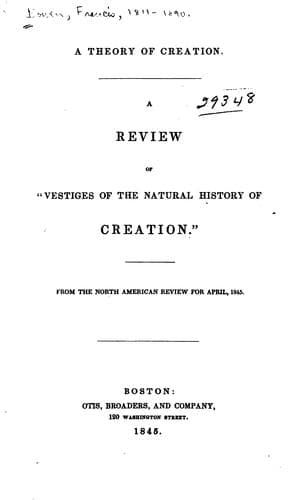
A Theory of Creation: A Review of 'Vestiges of the Natural History of Creation'Bowen, Francis
Religion
A Theory of Creation: A Review of 'Vestiges of the Natural History of Creation'
Bowen, Francis
Chambers, Robert, 1802-1871. Vestiges of the natural history of creation; Creation; Evolution (Biology)
months," at the end of which time we may reasonably suppose, that his
precautions ceased to have perfect effect. The only experiment, in which
adequate means to guard against causes of error were taken, was that of
Professor Schulze, of Berlin, which had a contrary result. We extract
Mr. Owen's account of it.
"He filled a glass flask half full of distilled water, in which
were various animal and vegetable substances: he then closed it
with a good cork, through which were passed two glass tubes, bent
at right angles, the whole being air-tight: it was next placed in a
sand bath, and heated until the water boiled violently. While the
watery vapor was escaping by the glass tubes, the Professor
fastened at each end an apparatus which chemists employ for
collecting carbonic acid: that at the one end was filled with
concentrated sulphuric acid, and the other with a solution of
potash. By means of the boiling heat, it is to be presumed that
every thing living, and all germs in the flask or in the tubes were
destroyed; whilst all access was cut off by the sulphuric acid on
the one side, and by the potash on the other. The apparatus was
then exposed to the influence of summer light and heat; at the same
time, there was placed near it an open vessel, with the same
substances that had been introduced into the flask, and also after
having subjected them to a boiling temperature. In order to renew
constantly the air within the flask, the experimenter sucked with
his mouth several times a day the open end of the apparatus, filled
with the solution of potash, by which process the air entered his
mouth from the flask through the caustic liquid, and the
atmospheric air from without entered the flask through the
sulphuric acid. The air was of course not at all altered in its
composition by passing through the sulphuric acid in the flask; but
all the portions of living matter, or of matter capable of becoming
animated, were taken up by the sulphuric acid and destroyed. From
the 28th of May until the beginning of August, Professor Schulze
continued uninterruptedly the renewal of the air in the flask,
without being able, by the aid of the microscope, to discover any
living animal or vegetable substance; although, during the whole of
the time, observations were made almost daily on the edge of the
liquid; and when, at last, the Professor separated the different
parts of the apparatus, he could not find in the whole liquid the
slightest trace of _Infusoria_ or _Confervae_, or of mould; but all
three presented themselves in great abundance a few days after he
had left the flask standing open. The vessel which he placed near
the apparatus contained on the following day _Vibriones_ and
_Monads_, to which were soon added larger Polygastric _Infusoria_,
Public-domain text, read in full here on John Shaqi.
Reviews
Reviews
No reviews yet
Be the first to share your thoughts on this work.
Join the Discussion
Join the discussion
Sign in to leave a comment or review.
Sign InorCreate an account