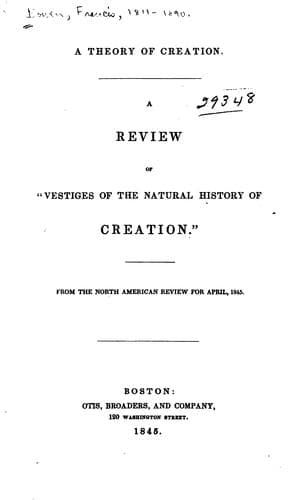
A Theory of Creation: A Review of 'Vestiges of the Natural History of Creation' — John Shaqi
A Theory of Creation: A Review of 'Vestiges of the Natural History of Creation'Bowen, Francis
Religion
A Theory of Creation: A Review of 'Vestiges of the Natural History of Creation'
Bowen, Francis
Chambers, Robert, 1802-1871. Vestiges of the natural history of creation; Creation; Evolution (Biology)
and afterwards _Rotifera_."--pp. 32, 33.
For readers who are not familiar with these subjects, it may be well to
mention, that the weight of authority is decidedly against this doctrine
of spontaneous generation. It is rejected by Mueller, who ranks among
the first physiologists of Germany; by Ehrenberg, one of the most
distinguished microscopists in the world; and by Owen, who stands at the
head of the school of comparative anatomy in England, if not in Europe.
The remark made by Cuvier, more than thirty years ago, is still true at
the present day, that, "although the impossibility of spontaneous
generation cannot be absolutely demonstrated, yet all the efforts of
those physiologists who believe in the possibility of it have not
succeeded in showing us a single instance."
Passing over, then, our author's theory of the origination of life from
inorganic matter as utterly untenable, we come to the next point in his
system,--the most chimerical of all,--the gradual development of the
higher orders of being out of those next beneath them in the scale. It
is not pretended, that there is _any known instance_ of the
transmutation of species, or of the evolution, in the ordinary way, of
any being specifically different from its parents. The same animal,
indeed, may pass through different grades of development; but these
changes affect only the individual, not the race. The progeny of this
animal must begin at the same point where its parent did, and run
precisely the same cycle. The tadpole becomes a frog, but the young of
that frog are tadpoles; the worm becomes a winged insect, but the eggs
of that insect are hatched into nothing but worms. These changes in the
life of the individual, like the successive periods of the embryotic
state, of infancy, and manhood in the human being, are perfectly
consistent with persistence of type in the race, and do not indicate
even the possibility that a new species may be developed out of an old
one. On the contrary, the germ must be considered as _potentially_
equivalent to the whole future being, for it is invariably developed
into that being. If there be any one fact unquestionably established by
observation, it is that each species invariably produces its like. "All
the phenomena," says Mueller, "at present observed in the animal kingdom,
seem to prove that the species were originally created distinct, and
independent of each other. There is no remote possibility of one species
being produced from another."
Public-domain text, read in full here on John Shaqi.
Reviews
Reviews
No reviews yet
Be the first to share your thoughts on this work.
Join the Discussion
Join the discussion
Sign in to leave a comment or review.
Sign InorCreate an account