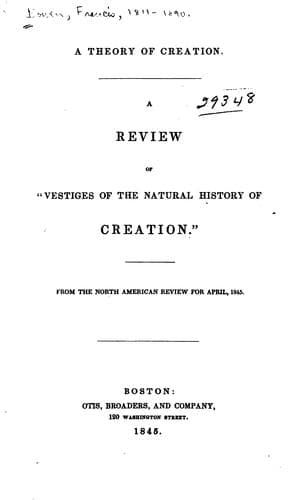
A Theory of Creation: A Review of 'Vestiges of the Natural History of Creation'Bowen, Francis
Religion
A Theory of Creation: A Review of 'Vestiges of the Natural History of Creation'
Bowen, Francis
Chambers, Robert, 1802-1871. Vestiges of the natural history of creation; Creation; Evolution (Biology)
The assertion, that man's "first form _is_ that which is permanent in
the animalcule,"--even if we do not look to the potentiality of
development into a higher being, which experience shows to exist in the
human germ, but not in the infusorial,--is a positive misstatement. The
lowest monad has a mouth and means for propagating its kind, which do
not belong to the primitive ovum of any higher animal. About the
succeeding stages in the growth of the embryo our author's language is
more cautious. He only says, that they _resemble_, or _typify_, some of
the lower orders of being; and this is virtually admitting a specific
difference, and giving up his own theory for all the conditions
posterior to that of the germ. The brain and heart of the embryo
successively _resemble_ the corresponding organs in a fish, a reptile, a
bird, and a quadruped; but they are not identical, _even in outward
appearance_, with those organs. Of course, if arrested at any stage of
its growth, and prematurely born, the embryo would not be one of the
lower animals, but only something resembling it in outward shape; and
conversely, if it were possible for the birth of a bird to be delayed
till it had reached a higher stage of development in the same line in
which it was proceeding, it would not become a quadruped, but it would
be an anomalous creature somewhat like one. Consequently, no one species
now on the earth can have been evolved out of any other existing race;
because the germs of any two, at a very early stage in their history,
according to our author's own confession, are specifically unlike.
To avoid this difficulty, he is driven to a further supposition, still
more gratuitous and improbable; namely, that the germ destined to become
one of a different race from its parents, having advanced along its
usual line of development so far as that line coincides with the one
belonging to the new species, there diverges, and follows a different
path up to the period of its birth into a new creature; that is, the
embryo of a reptile, having grown for a certain time as if it were to be
a reptile, suddenly turns aside, like a young man changing his mind
about the choice of a profession, and for the rest of its foetal life
follows the proper line of progress in order to be developed into a
bird. This is mere dreaming, and reminds one only of the wonderful
transformations effected by enchantment in an Arabian tale. We might
just as plausibly suppose, that the reptile, after it became mature, was
suddenly transformed into a bird, as that it underwent this change
before it was hatched. All the evidence attainable goes to show, that
the law of development is as immutable before as after birth, the
several stages of progress succeeding each other in a constant order,
and affecting the individual only, not the race. A young monkey is no
more likely to be transmuted into a man than an old one; nor is such a
metamorphosis at all more probable in the course of its foetal life.
Public-domain text, read in full here on John Shaqi.
Reviews
Reviews
No reviews yet
Be the first to share your thoughts on this work.
Join the Discussion
Join the discussion
Sign in to leave a comment or review.
Sign InorCreate an account