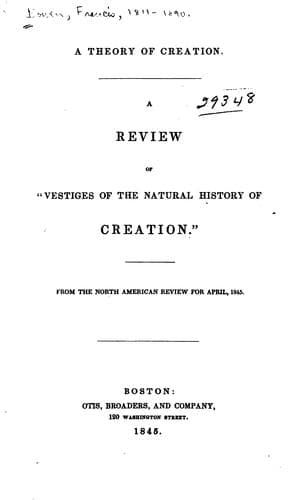
A Theory of Creation: A Review of 'Vestiges of the Natural History of Creation'Bowen, Francis
Religion
A Theory of Creation: A Review of 'Vestiges of the Natural History of Creation'
Bowen, Francis
Chambers, Robert, 1802-1871. Vestiges of the natural history of creation; Creation; Evolution (Biology)
The view we have now obtained of the specific differences between
distinct races of being at separate periods of their existence is
precisely what might have been anticipated from the law of gradual
development, which holds throughout the organic kingdoms. Between two
mature animals, these differences are perfectly obvious and well
marked. As we go a step back in their history, the distinction becomes a
little more obscure; two worms may resemble each other very closely,
though the two winged insects subsequently produced from them may be
very unlike. Receding still farther, some of these specific differences
may entirely disappear, the organs or parts which should exhibit them
being not yet developed. And when we come to the primitive germs, so
minute as to be visible only through the microscope, no outward
distinction, perhaps, is any longer perceptible, and the radical
difference of their internal organization is indicated only by the fact,
to be verified by subsequent observation, that the two are invariably
developed into perfectly distinct animals, belonging respectively to the
same races with their parents. A theorist, whose whole system is based
upon the invariable operation of natural agencies, cannot reasonably
object to this conclusion.
That our statements in the course of this argument may not appear of the
same questionable character as those advanced by our author, we will
fortify them with a few brief citations from a work of such
unquestionable authority as the Lectures of Professor Owen.
"No doubt the minute infusoria, which seem to have their
development arrested at the first or nearest stage from the
primitive cell formation, offer close and striking analogies to the
primitive cells out of which the higher animals and all their
tissues are developed; but the very [first] step which the
infusoria take beyond the primitive cell stage invests them with a
specific character as independent and distinct in its nature as
that of the highest and most complicated organisms. No mere organic
cell, destined for ulterior changes in a living organization, has a
mouth armed with teeth, or provided with long tentacula; I will not
lay stress on the alimentary canal and appended stomachs, which
many still regard as 'sub judice'; but the endowment of distinct
organs of generation, for propagating their kind by fertile ova,
raises the polygastric infusoria much above the mere organic
cell."--pp. 25, 26.
Public-domain text, read in full here on John Shaqi.
Reviews
Reviews
No reviews yet
Be the first to share your thoughts on this work.
Join the Discussion
Join the discussion
Sign in to leave a comment or review.
Sign InorCreate an account