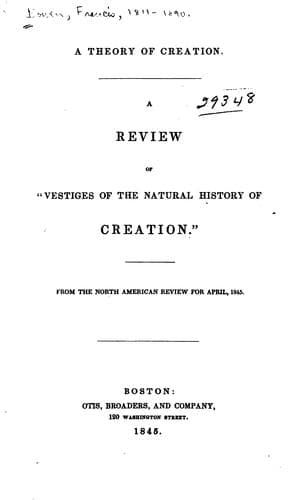
A Theory of Creation: A Review of 'Vestiges of the Natural History of Creation' — John Shaqi
A Theory of Creation: A Review of 'Vestiges of the Natural History of Creation'Bowen, Francis
Religion
A Theory of Creation: A Review of 'Vestiges of the Natural History of Creation'
Bowen, Francis
Chambers, Robert, 1802-1871. Vestiges of the natural history of creation; Creation; Evolution (Biology)
"In comparing the several stages in the very interesting
development of the _cyanaea aurita_ to the infusoria and polypes, it
must be understood that such comparisons are warranted only by a
similarity of outward form, and of the instruments of locomotion
and prehension. The essential internal organization of the
persistent lower forms of the _zooephyta_ is entirely wanting in the
transitory states of the higher ones. A progress through the
inferior groups is sketched out, but no actual transmutation of
species is effected. The young medusa, before it attains its
destined condition of maturity, successively resembles, but never
becomes, a polygastrian, a rotifer, and a bryozoon."--p. 112.
"Thus every animal in the course of its development typifies or
represents some of the permanent forms of animals inferior to
itself; but it does not represent all the inferior forms, nor
acquire the organization of any of the forms which it transitorily
represents. Had the animal kingdom formed, as was once supposed, a
single and continuous chain of being, progressively ascending from
the monad to the man, unity of organization might then have been
demonstrated to the extent in which the theory has been maintained
by the disciples of the Geoffroyan school."--p. 370.
If these similarities of structure in the germ had any bearing on the
subject, they would indicate the possibility only of retrogression in
the scale. Of course, the immature ovum, arrested in its development,
could not form a more perfect being than its parent. There is no
pretence that the embryo, at any stage of its progress, images an animal
of a higher grade than its own family. Then what aid do these
similarities of structure afford to the theory, that all the higher
organisms have been evolved by successive steps out of the lowest monad?
At the best, you have only shown, that a _retreat_ is possible; you have
still to point out any likelihood, even the remotest, of an _advance_ in
the scale of being. There is no fact whatever to confirm the
supposition, that birth may possibly be delayed till the animal be
developed into one of a higher species; and the law of immature births
seems to be, that, if the offspring escapes at all--for there is great
risk consequent on such an accident,--it becomes as perfect as its
progenitors. Nature seems to guard the distinctions between the several
races with peculiar care; so far as we know, monsters either do not
survive their birth, or are incapable of continuing their kind, or in
the course of a single generation are reunited to the original family.
Public-domain text, read in full here on John Shaqi.
Reviews
Reviews
No reviews yet
Be the first to share your thoughts on this work.
Join the Discussion
Join the discussion
Sign in to leave a comment or review.
Sign InorCreate an account