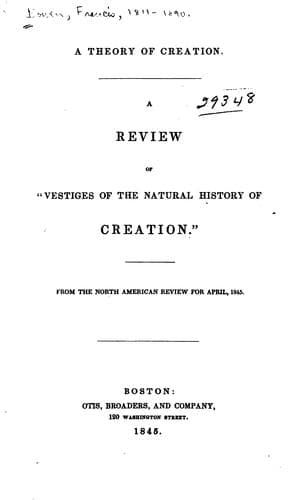
A Theory of Creation: A Review of 'Vestiges of the Natural History of Creation'Bowen, Francis
Religion
A Theory of Creation: A Review of 'Vestiges of the Natural History of Creation'
Bowen, Francis
Chambers, Robert, 1802-1871. Vestiges of the natural history of creation; Creation; Evolution (Biology)
We are not attempting to perplex a plain matter of science by
introducing into its discussion a metaphysical subtilty. The principle
here contended for is one of the first dictates of the inductive
philosophy, and as such it has been frankly acknowledged and acted upon
by all the great improvers of science in modern days. When Newton
discovered that the planets circle round the sun in the same manner in
which a stone thrown by the hand describes a curve before reaching the
earth, he may be said to have _explained_ the former phenomenon by
bringing it into the same class with certain results which have long
been familiar to us. But the explanation was only relative, not
absolute. The latter phenomenon is, in reality, no more explicable than
the former; he did not pretend to know the _cause_ of the stone's
falling to the ground, any more than of the revolution of the planets.
It was something to be able to arrange these apparently heterogeneous
results in the same class, and gravity was a convenient name to apply to
the whole. But the supposition, that gravity was an occult cause,
inherent in matter, he earnestly repelled, and declared that it was
"inconceivable."[2] Franklin showed, that a thunder-cloud and the
charged conductor of an electrical machine manifested the same
phenomena, and might therefore be classed together; sparks were obtained
from both, Leyden jars were charged from them, other bodies were
attracted and repelled in a similar way, so that it was reasonable to
believe that the same agency was acting in both cases. What this agency
was he did not even guess. The _cause_ of electric action, whether in
the excited cloud, or the excited tube, was just as obscure as ever.
Chemists observed, that different substances, when brought into close
contact, sometimes remained distinct, and sometimes united with each
other in various but regular proportions; and these capacities of
coalescing with one class of bodies, and of remaining unaffected by
another, are called chemical "affinities." This is a convenient
generalization, and has properly received a specific name; though the
common appellation throws no light on the _cause_ of the phenomena,
which remains an impenetrable secret. To say that certain action is
_caused_ by the operation of chemical affinities is only to arrange it
with a large class of other observed appearances, equally obscure as to
their origin and essential character.
Public-domain text, read in full here on John Shaqi.
Reviews
Reviews
No reviews yet
Be the first to share your thoughts on this work.
Join the Discussion
Join the discussion
Sign in to leave a comment or review.
Sign InorCreate an account