A Theory of Creation: A Review of 'Vestiges of the Natural History of Creation' — John Shaqi
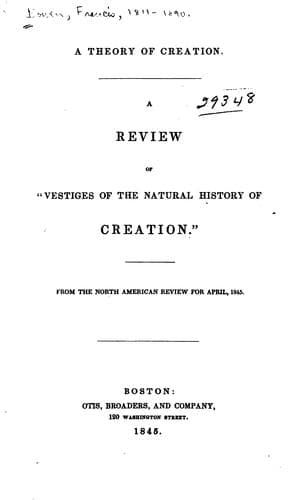
A Theory of Creation: A Review of 'Vestiges of the Natural History of Creation'Bowen, Francis
Religion
A Theory of Creation: A Review of 'Vestiges of the Natural History of Creation'
Bowen, Francis
Chambers, Robert, 1802-1871. Vestiges of the natural history of creation; Creation; Evolution (Biology)
Custom and convenience lead us to speak of the "laws" of nature, and of
the "powers and forces" of brute matter; and few persons, in adopting
these phrases, are aware that they are using a figure of speech. Yet
nothing is more certain than that all the researches of science have not
been able to point out with certainty a single active cause apart from
the operation of mind. We discern nothing but regularity and similarity
of sequences; and the attribution of these effects to some occult
qualities in the atoms or molecules in which they are manifested is
wholly hypothetical, and even, when closely examined, is inconceivable.
For this reason we affirm, that the theory of our author, professing to
account for the whole work of creation "by the operation of law," is not
only unsound and baseless in its particulars, but, when scrutinized as a
whole, is absolutely unintelligible. _He attempts to account for a
string of hypothetical effects, such as spontaneous generation and the
transmutation of species, by a series of hypothetical and inconceivable
causes, such as the energies of lifeless matter._ Let any one conceive,
if he can, of any _power_, _energy_, or _force_ inherent in a lump of
matter,--a stone, for instance,--except this merely negative one, that
it always and necessarily remains in its present state, whether this be
of rest or motion. Let him point out, if he can, the _nexus_ between
what are usually denominated cause and effect in matter,--as when two
bodies are drawn towards each other, if they are in opposite states of
electricity. When he says that it is the _nature_, or _law_, of bodies
thus electrified to attract each other, he offers no explanation of the
phenomenon; he only refers it to a class of other results, of a similar
character, previously observed. It is not pretended, that all or any of
these results, formerly known, are more intelligible or explicable than
the one in question. But the latter is classed with them, because, from
their general similarity, from their taking place under the same
outward circumstances, it is reasonably supposed that _one_ cause,
whatever it may be, is common to them all. And this is the whole
business of the student of nature, to place together results which are
so similar, that we may attribute them to a common cause, without
assuming to know what that cause is. The sole office of science is the
theory, not of causation, but of classification. It is all reducible to
natural history, the essence of which consists in arrangement.
Public-domain text, read in full here on John Shaqi.
Reviews
Reviews
No reviews yet
Be the first to share your thoughts on this work.
Join the Discussion
Join the discussion
Sign in to leave a comment or review.
Sign InorCreate an account