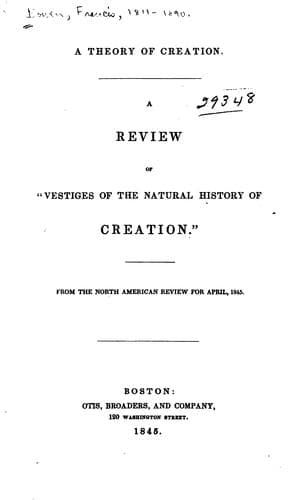
A Theory of Creation: A Review of 'Vestiges of the Natural History of Creation'Bowen, Francis
Religion
A Theory of Creation: A Review of 'Vestiges of the Natural History of Creation'
Bowen, Francis
Chambers, Robert, 1802-1871. Vestiges of the natural history of creation; Creation; Evolution (Biology)
An obvious corollary from these remarks is, that all _causation_ is an
exertion of mind, and is only figuratively applied to matter. It
necessarily implies power, will, and action. An efficient cause--we are
not speaking now of a mere antecedent--is that which is necessarily
followed by the effect, so that, if it were known, the effect might be
predicted antecedently to all experience. Cicero describes it with
philosophical accuracy. "_Causa ea est, quae id efficit, cujus est
causa._ _Non sic causa intelligi debet, ut quod cuique antecedat, id ei
causa sit; sed quod cuique_ EFFICIENTER _antecedat. Causis enim
efficientibus quamque rem cognitis, posse denique sciri quid futurum
esset._" Now, in the world of matter, we discover nothing but
antecedents and consequents; the former are the mere signs, not the
causes, of the latter; no necessary connection--no connection at all,
except sequence in time--can be discerned between them. Consequently,
from an examination of the former, we could not determine _a priori_,
that they must be followed by the latter, or by any other result
whatever. Our knowledge here, if knowledge it can be called, is wholly
empirical, or founded on experience. As we have seen, it is absurd to
say, that one atom of matter literally _acts_ on another. On the other
hand, in the world of mind, we are directly conscious of action, and
even of causation. All mental exertion is true action; every
determination of the will implies _effort_, or the direction and use of
power. The result to be accomplished is preconsidered, or meditated, and
therefore is known _a priori_, or before experience; the volition
succeeds, which is a true effort, or a power in action; and this, _if
the power be sufficient_, is _necessarily_ followed by the effect.
Volition is a true cause; but in a finite mind it is not always an
_adequate_ cause. If I will to shut my eyes, the effect immediately
follows as a necessary consequence. But if I will to stop the beating of
my heart, or to move a paralyzed limb, the effect does not follow,
because the power exerted is inadequate to the end proposed. The action
of the will is still _causative_, but it is _insufficient_.
Public-domain text, read in full here on John Shaqi.
Reviews
Reviews
No reviews yet
Be the first to share your thoughts on this work.
Join the Discussion
Join the discussion
Sign in to leave a comment or review.
Sign InorCreate an account