A Theory of Creation: A Review of 'Vestiges of the Natural History of Creation' — John Shaqi
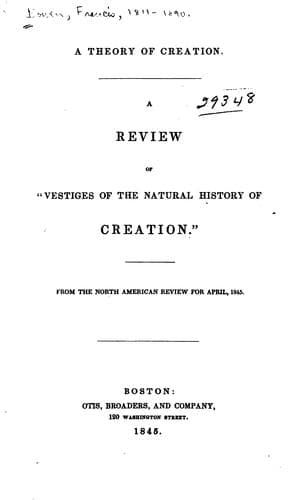
A Theory of Creation: A Review of 'Vestiges of the Natural History of Creation'Bowen, Francis
Religion
A Theory of Creation: A Review of 'Vestiges of the Natural History of Creation'
Bowen, Francis
Chambers, Robert, 1802-1871. Vestiges of the natural history of creation; Creation; Evolution (Biology)
It was from overlooking the distinction here made, that Hume, Kant, and
other metaphysicians were led to deny all knowledge of causation even in
the action of mind. They confounded sufficiency with efficiency, and
supposed, because the power did not always accomplish the end proposed,
that it did not tend towards it, or exert any effect upon it. As the
sufficiency of the volition can only be known _a posteriori_, or after
experience, they imagined that there could be no cause but that which is
infinite, or one which is invariably followed by the whole effect
contemplated. They overlooked the fact, that, in the consciousness of
_effort_,--as in the attempt to control the action of mind, to command
the attention, &c.,--we have direct and full evidence of _power in
action_, which is necessarily causal in its nature. The mental _nisus_
is true force, exerted with a foreknowledge of the effect to be
produced, and necessarily followed by a result,--a partial one it may
be,--but one which is a true effect, whether it answers the whole
intention, or not. Here, then, we discern that necessary connection
between two events, that absolute efficient agency, which was vainly
sought in the world of matter.
If these considerations are well founded, the whole framework of what
are called "secondary causes" falls to pieces. The laws of nature are
only a figure of speech; the powers and active inherent properties of
material atoms are mere fictions. Mind alone is active; matter is wholly
passive and inert. There is no such thing as what we usually call the
course of nature; it is nothing but the will of God producing certain
effects in a constant and uniform manner; which mode of action, however,
being perfectly arbitrary, is as easy to be altered at any time as to be
preserved. All events, all changes, in the external world, from the
least even unto the greatest, are attributable to his will and power,
which, being infinite, is always and necessarily adequate to the end
proposed. The laws of motion, gravitation, affinity, and the like, are
only expressions of the regularity and continuity of one infinite cause.
The order of nature is the effect of divine wisdom, its stability is the
result of divine beneficence.
"Estne Dei sedes nisi terra, et pontus, et aer,
Et coelum, et virtus? Superos quid quaerimus ultra?
Jupiter est quodcunque vides, quocunque moveris."
Public-domain text, read in full here on John Shaqi.
Reviews
Reviews
No reviews yet
Be the first to share your thoughts on this work.
Join the Discussion
Join the discussion
Sign in to leave a comment or review.
Sign InorCreate an account