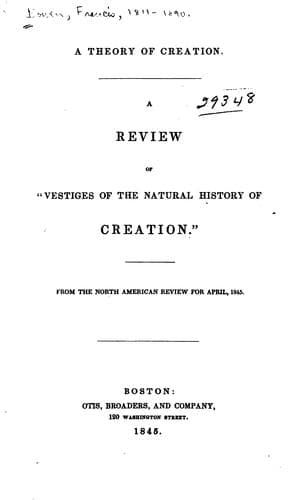
A Theory of Creation: A Review of 'Vestiges of the Natural History of Creation'Bowen, Francis
Religion
A Theory of Creation: A Review of 'Vestiges of the Natural History of Creation'
Bowen, Francis
Chambers, Robert, 1802-1871. Vestiges of the natural history of creation; Creation; Evolution (Biology)
The objection, that it is beneath the dignity of the Almighty--[Greek:
autourgein hapanta]--to put his hand to every thing--is founded on a
false analogy, as is seen by the form in which Aristotle states it. "If
it befit not the state and majesty of Xerxes, the great king of Persia,
that he should stoop to do all the meanest offices himself, much less
can this be thought suitable for God." The two cases do not correspond
in the very feature essential to the argument. An earthly potentate,
unable to execute with his own hand all the affairs of which he has
control, is obliged to delegate the larger portion of them to his
servants; selecting the lightest part for himself, he gratifies his
pride by calling it also the noblest, though the distinction is
factitious, there being no real difference, in point of honor or
dignity, between them. Omnipotence needs no minister, and is not
exhausted or wearied by the cares of a universe. Power in action is more
truly sublime than power in repose; and surely it is not derogatory to
divine energy to sustain and continue that which it was certainly not
beneath divine wisdom to create and appoint. Rightly considered, to
guide the falling of a leaf from a tree is an office as worthy of
omnipotence, as the creation of a world. "Are not two sparrows sold for
a farthing? and one of them shall not fall on the ground without your
Father. But the very hairs of your head are all numbered."
Equally lame is the oft-repeated comparison of the universe to a machine
of man's device, which is considered the more perfect the less mending
or interposition it requires. A machine is a labor-saving contrivance,
fitted to supply the weakness and deficiencies of him who uses it. Where
the want does not exist, it is absurd to suppose the creation of the
remedy. Human conceptions of the Deity are for ever at fault in imputing
to him the errors and deficiencies which belong to our own limited
faculties and dependent condition. Hence the idea of the Epicureans,
that sublime indifference and unbroken repose are the only states of
being worthy of the gods. Viewed in the light of true philosophy, no
less than of Christianity, how base and grovelling does this conception
appear! The sublime description of the pagan poet becomes the fitting
expression and defence of the very theory it was designed to
controvert:--
"Nam (proh sancta Deum tranquilla pectora pace,
Quae placidum degunt aevum, vitamque serenam!)
Quis regere immensi summam, quis habere profundi
Indu manu validas potis est moderanter habenas?
Quis pariter coelos omneis convertere? et omneis
Ignibus aetheriis terras suffire feraceis?
Omnibus inque locis esse omni tempore presto?
Nubibus ut tenebras faciat, coelique serena
Concutiat sonitu? tum fulmina mittat, et aedeis
Saepe suas disturbet?"
Public-domain text, read in full here on John Shaqi.
Reviews
Reviews
No reviews yet
Be the first to share your thoughts on this work.
Join the Discussion
Join the discussion
Sign in to leave a comment or review.
Sign InorCreate an account