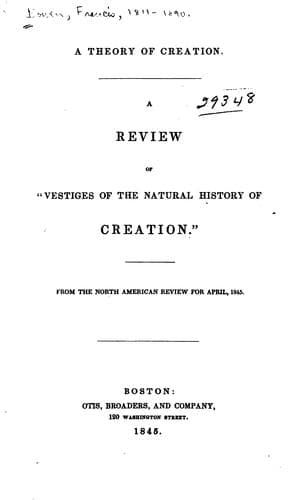
A Theory of Creation: A Review of 'Vestiges of the Natural History of Creation' — John Shaqi
A Theory of Creation: A Review of 'Vestiges of the Natural History of Creation'Bowen, Francis
Religion
A Theory of Creation: A Review of 'Vestiges of the Natural History of Creation'
Bowen, Francis
Chambers, Robert, 1802-1871. Vestiges of the natural history of creation; Creation; Evolution (Biology)
But during the period of its existence, how close and intimate in
appearance is this union with the body! Sensation extends to every part
of it, every fibre is instinct with life, and the direction of the will
is absolute and immediate over every muscle and joint, as if the whole
fabric and its tenant were one homogeneous system. The will tires not of
its supremacy, and is not wearied with the number of volitions required
of it to keep every joint in action, and every organ performing its
proper function. It would not delegate the control of the fingers to an
inferior power, nor contrive mechanical or automatic means for moving
the extremities. Within its sphere, it is sole sovereign, and is not
perplexed with the variety and constant succession of its duties,
extending to every part of the complex structure of which it is the
animating and directing spirit. Sensation is not cumbered with the
multitude of impressions it receives, nor is the fineness of perception
dulled by repeated exercise. The sharpness of its edge rather improves
by use, and we become more heedful of its lightest intimations. Is it
irreverent, then, to suppose that this union of body and soul shadows
forth the connection between the material universe and the Infinite One?
How else, indeed, can we attach any meaning to the attributes of
omnipresence and omnipotence? The unity of action, the regularity of
antecedence and consequence in outward events, which we commonly
designate by the lame metaphor of _law_, then become the fitting
expression of the consistent doings of an all-wise Being, in whom there
is no variableness, neither shadow of turning. The Creator, then, is no
longer banished from his creation, nor is the latter an orphan, or a
deserted child. It is not a great machine, that was wound up at the
beginning, and has continued to run on ever since, without aid or
direction from its artificer. As well might we conceive of the body of a
man moving about, and performing all its appropriate functions, without
the principle of life, or the indwelling of an immortal soul. The
universe is not lifeless or soulless. It is informed by God's spirit,
pervaded by his power, moved by his wisdom, directed by his beneficence,
controlled by his justice.
"Spiritus intus alit, totamque infusa per artus
Mens agitat molem, et magno se corpore miscet."
The harmony of physical and moral laws is not a mere fancy, nor a forced
analogy; they are both expressions of the same will, manifestations of
the same spirit.
Public-domain text, read in full here on John Shaqi.
Reviews
Reviews
No reviews yet
Be the first to share your thoughts on this work.
Join the Discussion
Join the discussion
Sign in to leave a comment or review.
Sign InorCreate an account