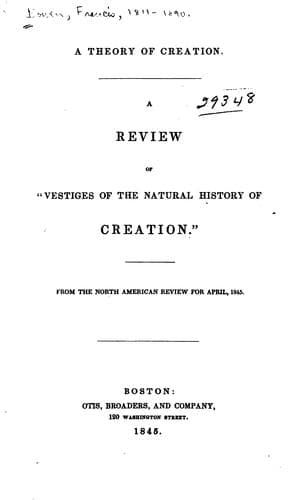
A Theory of Creation: A Review of 'Vestiges of the Natural History of Creation'Bowen, Francis
Religion
A Theory of Creation: A Review of 'Vestiges of the Natural History of Creation'
Bowen, Francis
Chambers, Robert, 1802-1871. Vestiges of the natural history of creation; Creation; Evolution (Biology)
Having thus explained the _genesis_ of the solar system, we come down to
the history of our own earth, since it shelled off the ring which formed
our moon. Continuing to cool down and shrink, a thin but rigid crust of
primary rocks, still bearing marks of the intense heat to which they
have been subjected, was formed upon its surface; and then the vapors,
with which the atmosphere had been charged, were condensed, and formed
seas, which covered the whole, or the greater part, of the earth's
rind. The continual agitation of these waters, and their high
temperature, as they were still nearly at the boiling point,
disintegrated and wore down many of these rocks, and, in the lapse of
ages, deposited their remains, in thick layers of sand and mud, at the
bottom of the seas. Baked by the heat from beneath, and pressed by the
weight of superincumbent waters, these layers slowly hardened into
stratified rocks. Forms of vegetable and animal life, though only of the
lowest type, the origin of which is to be explained hereafter, now began
to appear. Some sea-plants, zooephytes, infusory animalcules, and a few
of the molluscous tribe, all low down in the order of being, but
important from their immense numbers and joint action, commenced their
work of absorbing the carbonic acid with which the air was overcharged,
and building up vast piers and mounds of stone from their own remains.
Meanwhile, the internal fires of the earth occasionally broke through
the rocky crust that imprisoned them, threw up liquid primitive rock
through the rents, and distorted and tilted up the strata that had been
formed above.
Public-domain text, read in full here on John Shaqi.
Reviews
Reviews
No reviews yet
Be the first to share your thoughts on this work.
Join the Discussion
Join the discussion
Sign in to leave a comment or review.
Sign InorCreate an account