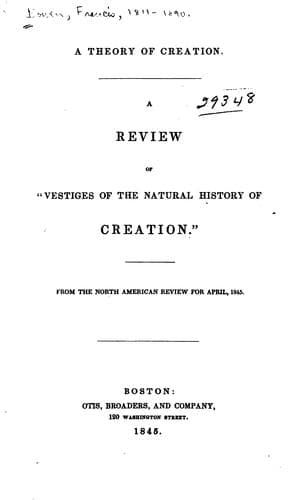
A Theory of Creation: A Review of 'Vestiges of the Natural History of Creation' — John Shaqi
A Theory of Creation: A Review of 'Vestiges of the Natural History of Creation'Bowen, Francis
Religion
A Theory of Creation: A Review of 'Vestiges of the Natural History of Creation'
Bowen, Francis
Chambers, Robert, 1802-1871. Vestiges of the natural history of creation; Creation; Evolution (Biology)
We may remark, in passing, that the chronology of the events of which we
now speak is not very accurately determined; the only thing certain
about it is, that a series of ages, so protracted that the imagination
cannot conceive their number, elapsed between the successive epochs in
the history of the earth's crust. Some of the convulsions caused by the
fiery mass within threw up rock above the surface of the waters, and
thus the dry land began to appear. Islands were formed, and immediately
land-plants made their appearance, of excessive luxuriance, under the
tropical temperature that still prevailed all over the globe, and began
their office of absorbing carbon, and storing it up for future use.
Land-animals as yet were not, for the excess of carbonic acid in the
atmosphere rendered it incapable of supporting animal life. But the
richness of this island vegetation gradually purified the air; while the
decaying plants themselves, being accumulated into vast beds and strata,
and subjected, through the changes of the earth's surface, to the
pressure of mighty waters, gradually formed immense deposits of coal,
for the subsequent service of man. Animals of a higher grade were now
formed; fishes became abundant, and amphibious monsters, huge lizards
and other reptiles, with an imperfect apparatus of respiration, began to
breathe an atmosphere not yet fitted for birds and mammifers.
It is not necessary to trace out the comparatively well known facts and
theories of geological science, that are incorporated into this history.
It is enough, for the present purpose, to point out a few of the general
conclusions of the geologist respecting the several great changes that
the earth's crust has undergone, and the distinct races of vegetables
and animals which have successively tenanted the earth's surface. These
changes and these races have borne a constant relation to each other; as
the scenes shifted, the inhabitants also changed, the latter being
always adapted to the circumstances in which they were placed. There has
been a constant progress, the soil and the atmosphere becoming more and
more fitted for the support of the higher forms of life; and when all
things were thus made ready for them, these higher forms have appeared,
and the lower orders of being, which formerly occupied the scene, have
entirely died out, so that their remains, entombed in the solid rock,
are now the only indications of their past existence. In the era of the
primary rocks, as we have seen, there was no organization or life, as
there was nothing to support it. In the succeeding period, zooephytes and
mollusca appeared; these were followed by fishes, and then land rose
above the surface of the waters. Land-plants and animals came next,
though of a low type; continually advancing orders of beings, reptiles,
birds, and mammifers, suited to the improved condition of things,
successively appeared, until, at the latest epoch, man entered upon the
Public-domain text, read in full here on John Shaqi.
Reviews
Reviews
No reviews yet
Be the first to share your thoughts on this work.
Join the Discussion
Join the discussion
Sign in to leave a comment or review.
Sign InorCreate an account