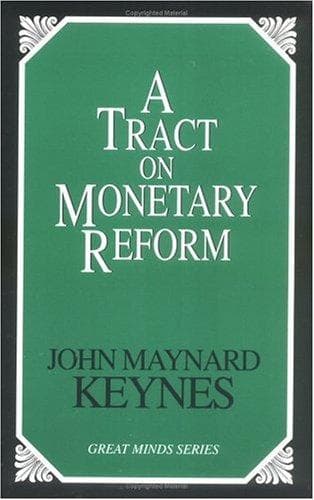
The temporary recovery in Germany after the collapse of February 1923
exhibited how a point may come when, if the money is to continue in
use at all, a bottom is reached and a technical position is created in
which some recovery is possible. When the gold value of the currency
has fallen to a very low figure, it is easy for the Government, if
it has any external resources at all, to give sufficient support to
prevent the exchange from falling further for the time being. And since
by that time the public will have carried their attempts to economise
the use of money to a pitch of inconvenience which it is impracticable
to continue, even a moderate weakening in the degree of their distrust
of the future value of the money will lead to some increase in their
use of it; with the result that the aggregate value of the note issue
will tend to recover. By February 1923 these conditions existed in
Germany in a high degree. The German Government was able within two
months, in the face of most adverse political conditions, to double the
exchange-value of the mark whilst simultaneously more than doubling
the note circulation. Even so the gold value of the note issue was
only brought back to what it had been six months earlier; and if even
a moderate degree of confidence had been restored, it might have been
possible to bring the value of the note circulation of Germany up to
(say) 2 milliard gold marks (£100,000,000) at least, which is probably
about the lowest figure at which it can stand permanently, unless every
one is to put himself to intolerable inconvenience in his efforts to
hold as little money as possible. Incidentally the Government is able
during the period of recovery to obtain, once more, through the issue
of notes the command over a considerable amount of real resources.
In Austria, where, at the date of writing, the exchange has been
stabilised for a year, the same phenomenon has been apparent with
the growth of confidence, the gold value of the note issue having
been raised to nearly two and a half times the low point reached in
September 1922. The fact of stabilisation, with foreign aid, has,
by increasing confidence, permitted this increase of the note issue
without imperilling the stabilisation, and will probably permit in
course of time a substantial further increase.
Public-domain text, read in full here on John Shaqi.
Reviews
Reviews
No reviews yet
Be the first to share your thoughts on this work.
Join the Discussion
Join the discussion
Sign in to leave a comment or review.
Sign InorCreate an account