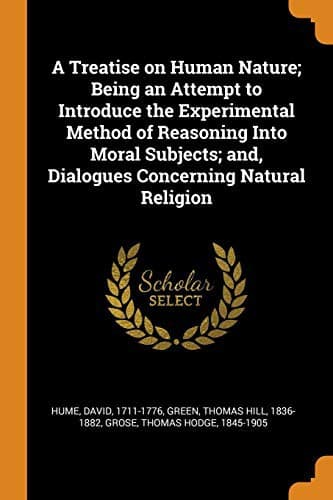
A Treatise of Human Nature: Being an Attempt to Introduce the Experimental Method Into Moral Subjects; and Dialogues Concerning Natural ReligionHume, David
PhilosophyPhilosophy
A Treatise of Human Nature: Being an Attempt to Introduce the Experimental Method Into Moral Subjects; and Dialogues Concerning Natural Religion
Hume, David
Emotions; Ethics; Knowledge, Theory of; Philosophy, English
[4] But meanwhile, behind this unknown substance,
whether of spirit or of body, the self-consciousness, which has been
treated as its occasional unessential operation, re-asserts itself as
the self which claims both body and spirit, the immaterial no less
than the material substance, as its own, and throughout whatever
diversity in these maintains its own identity.
[1] See above, paragraph 94 and the following.
[2] See above, paragraph 125.
[3] Locke, Essay ii. chap. i. sec. 10, etc.
[4] See above, paragraph 106, near the end.
We think not always, yet thought constitutes the self.
134. Just, then, as Locke’s conception of outward reality grows
under his hands into a conception of nature as a system of relations
which breaks through the limitations of reality as constituted
by mere _individua_, so it is with the self, as he conceived it.
It is not a simple idea. It is not one of the train that is for
ever passing, ‘one going and another coming,’ for it looks on this
succession as that which it experiences, being itself the same
throughout the successive differences (Book II. chap. vii. sec. 9,
and chap. xxvii. sec. 9). As little can it be adjusted to any of
the conditions of real ‘things,’ thinking or unthinking, which he
ordinarily recognises. It has no ‘particularity in space and time.’
That which is past in ‘reality’ is to it present. It is ‘in its
nature indifferent to any parcel of matter.’ It is the same with
itself yesterday and to-day, here and there. That ‘with which its
consciousness can join itself is one self with it,’ and it can so
join itself with substances apart in space and remote in time (Book
II. chap, xxvii. secs. 9, 13, 14, 17). For speaking of it as eternal,
indeed, we could find no warrant in Locke. He does not so clearly
distinguish it from the ‘thinking thing’ supposed to be within each
man, that has ‘had its determinate time and place of beginning to
exist, relation to which determines its identity so long as it
exists’ (Book II. chap. xxvii. sec. 2). Hence he supposed an actual
limit to the past which it could make present--a limit seemingly
fixed for each man at the farthest by the date of his birth--though
he talks vaguely of the possibility of its range being extended (Book
II. chap. xxvii. sec. 16). In the discussion of personal identity,
however, the distinction gradually forces itself upon him, and he at
last expressly says (sec. 16), that if the same Socrates, sleeping
and waking, do not partake of the same consciousness (as according to
Book II. chap. i. sec. 11 he certainly does not), ‘Socrates sleeping
and waking is not the same person;’ whereas the ‘thinking thing’--the
substance of which consciousness is a power sometimes exercised,
sometimes not--is the same in the sleeping as in the waking Socrates.
This is a pregnant admission, but it brings nothing to the birth in
Locke himself. The inference which it suggests to his reader, that
a self which does not slumber or sleep is not one which is born or
Public-domain text, read in full here on John Shaqi.
Reviews
Reviews
No reviews yet
Be the first to share your thoughts on this work.
Elsewhere in the archive
Join the Discussion
Join the discussion
Sign in to leave a comment or review.
Sign InorCreate an account