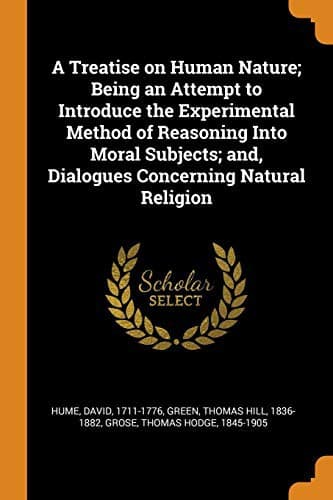
A Treatise of Human Nature: Being an Attempt to Introduce the Experimental Method Into Moral Subjects; and Dialogues Concerning Natural ReligionHume, David
PhilosophyPhilosophy
A Treatise of Human Nature: Being an Attempt to Introduce the Experimental Method Into Moral Subjects; and Dialogues Concerning Natural Religion
Hume, David
Emotions; Ethics; Knowledge, Theory of; Philosophy, English
and objective, of fantastic and real, would not exist; but neither
would knowledge or a world to be known. That such oppositions,
misunderstood, may be a heavy burden on the human spirit, the
experience of current controversy and its spiritual effects might
alone suffice to convince us; but the philosophical deliverance can
only lie in the recognition of thought as their author, not in the
attempt to obliterate them by the reduction of thought and its world
to feeling--an attempt which contradicts itself, since it virtually
admits their existence while it renders them unaccountable.
Which, if idea = feeling, does away with space and body.
174. That Berkeley’s was such an attempt, looking merely to his
treatment of primary qualities and abstract ideas, we certainly could
not doubt: though, since language does not allow of its consistent
statement, and Berkeley was quite ready to turn the exigencies of
language to account, passages logically incompatible with it may
easily be found in him. The hasty reader, when he is told that body
or distance are suggested by feelings of sight and touch rather than
immediately seen, accepts the doctrine without scruple, because he
supposes that which is suggested to be a present reality, though
not at present felt. But if not at present felt it is not according
to Berkeley an idea, therefore ‘without the mind,’ therefore an
impossibility. [1] That which is suggested, then, must itself be
a feeling which consists in the expectation of other feelings.
Distance, and body, _as suggested_, can be no more than such an
expectation; and as _actually existing_, no more than the actual
succession of the expected feelings--a succession of which, as of
every succession, ‘no two parts exist together.’ [2] There is no
time, then, at which it can be said that distance and body exist.
[1] Reference is here merely made to the doctrine by which Berkeley
disposes of ‘matter,’ the consideration of its reconcilability with
his doctrine of ‘spirits’ and ‘relations’ as objects of knowledge
being postponed.
[2] Locke, Book II. chap. xv. sec. 1.
He does not even retain them as ‘abstract ideas’.
Public-domain text, read in full here on John Shaqi.
Reviews
Reviews
No reviews yet
Be the first to share your thoughts on this work.
Elsewhere in the archive
Join the Discussion
Join the discussion
Sign in to leave a comment or review.
Sign InorCreate an account