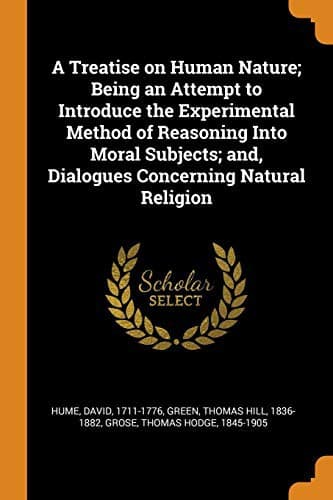
A Treatise of Human Nature: Being an Attempt to Introduce the Experimental Method Into Moral Subjects; and Dialogues Concerning Natural ReligionHume, David
PhilosophyPhilosophy
A Treatise of Human Nature: Being an Attempt to Introduce the Experimental Method Into Moral Subjects; and Dialogues Concerning Natural Religion
Hume, David
Emotions; Ethics; Knowledge, Theory of; Philosophy, English
175. This, it may seem, however inconsistent with the doctrine of
primary qualities, is little more than the result which Locke himself
comes to in his Fourth Book; since, if ‘actual present succession’
forms our only knowledge of real existence, there could be no time
at which distance and body might be _known_ as really existing. But
Locke, as we have seen, is able to save mathematical, though not
physical, knowledge from the consequences of this admission by his
doctrine of abstract ideas--‘ideas removed in our thoughts from
particular existence’--whose agreement or disagreement is stated
in propositions which ‘concern not existence,’ and for that reason
may be general without becoming either uncertain or uninstructive.
This doctrine Berkeley expressly rejects on the ground that he
could not perceive separately that which could not exist separately
(‘Principles of Human Knowledge,’ Introduction, sec. 10); a ground
which to the ordinary reader seems satisfactory because he has no
doubt, and Berkeley’s instances do not suggest a doubt, as to the
present existence of ‘individual objects’--this man, this horse,
this body. But with Berkeley to exist means to be felt (‘Principles
of Human Knowledge,’ sec. 3), and the feelings, which I name a body,
being successive, its existence must be in succession likewise. The
limitation, then, of possibility of ‘conception’ by possibility of
existence, means that ‘conception,’ too, is reduced to a succession
of feelings.
On the same principle all permanent relations should disappear.
176. Berkeley, then, as a consequence of the methods by which he
disposes at once of the ‘real existence’ and ‘abstract idea of
matter,’ has to meet the following questions:--How are either reality
or knowledge possible without permanent relations? and, How can
feelings, of which one is over before the next begins, constitute
or represent a world of permanent relations? The difficulty becomes
more obvious, though not more serious, when the relations in question
are not merely themselves permanent, as are those between natural
phenomena, but are relations between permanent parts like those of
space. It is for this reason that its doctrine of geometry is the
most easily assailable point of the ‘sensational’ philosophy. Locke
distinguishes the ideas of space and of duration as got, the one
from the permanent parts of space, the other ‘from the fleeting and
perpetually perishing parts of succession.’ [1] He afterwards prefers
to oppose the term ‘expansion’ to ‘duration,’ as bringing out more
clearly than ‘space’ the opposition of relation between permanent
facts to that between ‘fleeting successive facts which never exist
together.’ How, then, can a consciousness, consisting simply of
‘fleeting successive facts,’ either be or represent that of which the
differentia is that its facts are permanent and co-exist?
[1] Book II. chap. xiv. sec. 1.
By making colour = relations of coloured points, Berkeley represents
relation as seen.
Public-domain text, read in full here on John Shaqi.
Reviews
Reviews
No reviews yet
Be the first to share your thoughts on this work.
Elsewhere in the archive
Join the Discussion
Join the discussion
Sign in to leave a comment or review.
Sign InorCreate an account