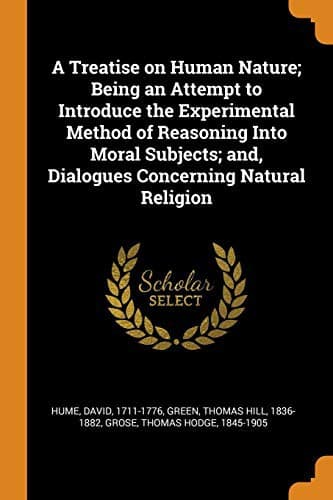
A Treatise of Human Nature: Being an Attempt to Introduce the Experimental Method Into Moral Subjects; and Dialogues Concerning Natural ReligionHume, David
PhilosophyPhilosophy
A Treatise of Human Nature: Being an Attempt to Introduce the Experimental Method Into Moral Subjects; and Dialogues Concerning Natural Religion
Hume, David
Emotions; Ethics; Knowledge, Theory of; Philosophy, English
177. This crucial question in regard to extension does not seem even
to have suggested itself to Berkeley. The reason why is not far to
seek. Professor Fraser, in his valuable edition, represents him as
meaning by visible extension ‘coloured experience in sense,’ and by
tangible extension ‘resistent experience in sense.’ [1] No fault can
be found with this interpretation, but the essential question, which
Berkeley does not fairly meet, is whether the experience in each
case is complete in a single feeling or consists in a succession of
feelings. If in a single feeling, it clearly is not extension, as a
relation between parts, at all; if in a succession of feelings, it
is only extension because a synthetic principle, which is not itself
one of the feelings, but equally present to them all, transforms
them into permanent parts of which each qualifies the other by
outwardness to it. Berkeley does not see the necessity of such a
principle, because he allows himself to suppose extension--at any
rate visible extension--to be constituted by a single feeling.
Having first pronounced that the proper object of sight is colour,
he quietly substitutes for this _situations_ of colour, degrees of
strength and faintness in colour, and quantities of coloured points,
as if these, interchangeably with mere colour, were properly objects
of sight and perceived in single acts of vision. Now if by object of
sight were meant something other than the sensation itself--something
which to a thinking being it suggests as its cause--there would be
no harm in this language, but neither would there be any ground for
saying that the proper object of sight is colour, for distinguishing
visible from tangible extension, or for denying that the outwardness
of body to body is seen. Such restrictions and distinctions have
no meaning, unless by sight is meant the nervous irritation, the
affection of the visual organ, as it is to a merely feeling subject;
yet in the very passages where he makes them, by saying that we see
situations and degrees of colour, and quantities of coloured points,
Berkeley converts sight into a judgment of extensive and intensive
quantity. He thus fails to discern that the transition from colour
to coloured extension cannot be made without on the one hand either
the presentation of successive pictures or (which comes to the
same) successive acts of attention to a single picture, and on the
other hand a synthesis of the successive presentations as mutually
qualified parts of a whole. In other words, he ignores the work of
thought involved in the constitution alike of coloured and tangible
extension, and in virtue of which alone either is extension at all.
[1] See Fraser’s Berkeley, ‘Theory of Vision,’ note 42. I may here
say that I have gone into less detail in my account of Berkeley’s
system than I should otherwise have thought necessary, because
Professor Fraser has supplied, in the way of explanation of it, all
that a student can require.
Public-domain text, read in full here on John Shaqi.
Reviews
Reviews
No reviews yet
Be the first to share your thoughts on this work.
Elsewhere in the archive
Join the Discussion
Join the discussion
Sign in to leave a comment or review.
Sign InorCreate an account