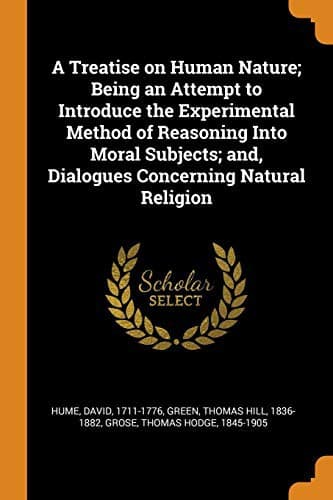
A Treatise of Human Nature: Being an Attempt to Introduce the Experimental Method Into Moral Subjects; and Dialogues Concerning Natural ReligionHume, David
PhilosophyPhilosophy
A Treatise of Human Nature: Being an Attempt to Introduce the Experimental Method Into Moral Subjects; and Dialogues Concerning Natural Religion
Hume, David
Emotions; Ethics; Knowledge, Theory of; Philosophy, English
Still he admits that space is constituted by a succession of feelings.
178. But though he does not scruple to substitute for colour
situations and quantities of coloured points, these do not with him
constitute space, which he takes according to Locke’s account of it
to be ‘distance between bodies or parts of the same body.’ This,
according to his ‘Theory of Vision,’ is tangible extension, and
this again is alone the object of geometry. As in that treatise a
difference is still supposed between _tangible_ extension and the
feeling of touch, the question does not there necessarily arise
whether the tactual experience, that constitutes this extension, is
complete in a single feeling or only in a succession of feelings;
but when in the subsequent treatise the difference is effaced, it is
decided by implication that the experience is successive: [1] and all
received modifications of the theory, which assign to a locomotive or
muscular sense the office which Berkeley roughly assigned to touch,
make the same implication still more clearly. Now in the absence of
any recognition of a synthetic principle, in relation to which the
successive experience becomes what it is not in itself, this means
nothing else than that space is a succession of feelings, which again
means that space is not space, not a qualification of bodies or parts
of body by mutual externality, since to such qualification it is
necessary that bodies or their parts coexist. Thus, in his hurry to
get rid of externality as independence of the mind, he has really got
rid of it as a relation between bodies, and in so doing (however the
result may be disguised) has logically made a clean sweep of geometry
and physics.
[1] ‘Principles of Human Knowledge,’ sec. 44. It will be observed
that in that passage Berkeley uses the term ‘distance’ not ‘space,’
and though with him the terms are strictly interchangeable, this
may have helped to disguise from him the full monstrosity of the
doctrine, ‘space is a succession of feelings,’ which, stated in that
form, must surely have scandalised him.
If so, it is not space at all; but Berkeley thinks it is only not
‘pure’ space. _Space_ and _pure_ space stand or fall together.
Public-domain text, read in full here on John Shaqi.
Reviews
Reviews
No reviews yet
Be the first to share your thoughts on this work.
Elsewhere in the archive
Join the Discussion
Join the discussion
Sign in to leave a comment or review.
Sign InorCreate an account