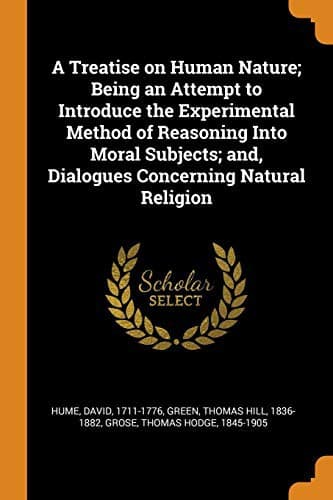
A Treatise of Human Nature: Being an Attempt to Introduce the Experimental Method Into Moral Subjects; and Dialogues Concerning Natural ReligionHume, David
PhilosophyPhilosophy
A Treatise of Human Nature: Being an Attempt to Introduce the Experimental Method Into Moral Subjects; and Dialogues Concerning Natural Religion
Hume, David
Emotions; Ethics; Knowledge, Theory of; Philosophy, English
philosophy is a matter about which there has been much guessing by
great intellects, but no definite truth is to be attained. It is
otherwise with those who see in philosophy a progressive effort
towards a fully-articulated conception of the world as rational. To
them its past history is of interest as representing steps in this
progress which have already been taken for us, and which, if we will
make them our own, carry us so far on our way towards the freedom of
perfect understanding; while to ignore them is not to return to the
simplicity of a pre-philosopic age, but to condemn ourselves to grope
in the maze of ‘cultivated opinion,’ itself the confused result of
those past systems of thought which we will not trouble ourselves to
think out.
Object of the present enquiry.
5. The value of that system of thought, which found its clearest
expression in Hume, lies in its being an effort to think to
their logical issue certain notions which since then have become
commonplaces with educated Englishmen, but which, for that reason, we
must detach ourselves from popular controversy to appreciate rightly.
We are familiar enough with these in the form to which adaptation to
the needs of plausibility has gradually reduced them, but because
we do not think them out with the consistency of their original
exponents, we miss their true value. They do not carry us, as they
will do if we restore their original significance, by an intellectual
necessity to those truer notions which, in fact, have been their
sequel in the development of philosophy, but have not yet found their
way into the ‘culture’ of our time. An attempt to restore their
value, however, if this be the right view of its nature, cannot but
seem at first sight invidious. It will seem as if, while we talk of
their value, we were impertinently trying to ‘pull them to pieces.’
But those who understand the difference between philosophical
failures, which are so because they are anachronisms, and those which
in their failure have brought out a new truth and compelled a step
forward in the progress of thought, will understand that a process,
which looks like pulling a great philosopher to pieces, may be the
true way of showing reverence for his greatness. It is a Pharisaical
way of building the sepulchres of philosophers to profess their
doctrine or extol their genius without making their spirit our own.
The genius of Locke and Hume was their readiness to follow the lead
of Ideas: their spirit was the spirit of Rationalism--the spirit
which, however baffled and forced into inconsistent admissions,
is still governed by the faith that all things may ultimately be
understood. We best do reverence to their genius, we most truly
appropriate their spirit, in so exploring the difficulties to which
their enquiry led, as to find in them the suggestion of a theory
which may help us to walk firmly where they stumbled and fell.
Locke’s problem and method.
Public-domain text, read in full here on John Shaqi.
Reviews
Reviews
No reviews yet
Be the first to share your thoughts on this work.
Join the Discussion
Join the discussion
Sign in to leave a comment or review.
Sign InorCreate an account