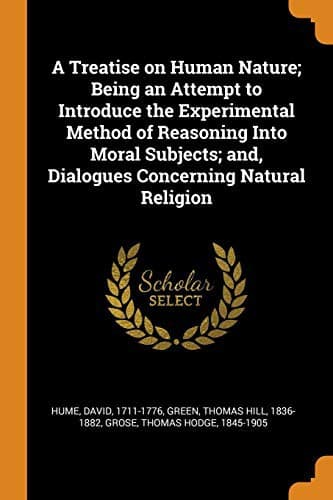
A Treatise of Human Nature: Being an Attempt to Introduce the Experimental Method Into Moral Subjects; and Dialogues Concerning Natural ReligionHume, David
PhilosophyPhilosophy
A Treatise of Human Nature: Being an Attempt to Introduce the Experimental Method Into Moral Subjects; and Dialogues Concerning Natural Religion
Hume, David
Emotions; Ethics; Knowledge, Theory of; Philosophy, English
6. About Locke, as about every other philosopher, the essential
questions are, What was his problem, and what was his method?
Locke, as a man of business, gives us the answers at starting. His
problem was the origin of ‘ideas’ in the individual man, and their
connection as constituting knowledge: his method that of simply
‘looking into his own understanding and seeing how it wrought.’
These answers commend themselves to common sense, and still form
the text of popular psychology. If its confidence in their value,
as explained by Locke, is at all beginning to be shaken, this is
not because, according to a strict logical development, they issued
in Hume’s unanswered scepticism, which was too subtle for popular
effect, but because they are now open to a rougher battery from the
physiologists. Our concern at present is merely to show their precise
meaning, and the difficulties which according to this meaning they
involve.
His notion of the ‘thinking thing’.
7. There are two propositions on which Locke is constantly insisting:
one, that the object of his investigation is _his own_ mind; the
other, that his attitude towards this object is that of mere
observation. He speaks of his own mind, it is to be noticed, just
as he might of his own body. It meant something born with, and
dependent on, the particular animal organism that first saw the
light at Wrington on a particular day in 1632. It was as exclusive
of other minds as his body of other bodies, and he could only infer
a resemblance between them and it. With all his animosity to the
coarse spiritualism of the doctrine of innate ideas, he was the
victim of the same notion which gave that doctrine its falsehood and
grotesqueness. He, just as much as the untutored Cartesian, regarded
the ‘minds’ of different men as so many different things; and his
refutation of the objectionable hypothesis proceeds wholly from this
view. Whether the mind is put complete into the body, or is born and
grows with it; whether it has certain characters stamped upon it to
begin with, or receives all its ideas through the senses; whether it
is simple and therefore indiscerptible, or compound and therefore
perishable--all these questions to Locke, as to his opponents,
concern a multitude of ‘thinking things’ in him and them, merely
individual, but happening to be pretty much alike.
This he will passively observe.
Public-domain text, read in full here on John Shaqi.
Reviews
Reviews
No reviews yet
Be the first to share your thoughts on this work.
Join the Discussion
Join the discussion
Sign in to leave a comment or review.
Sign InorCreate an account