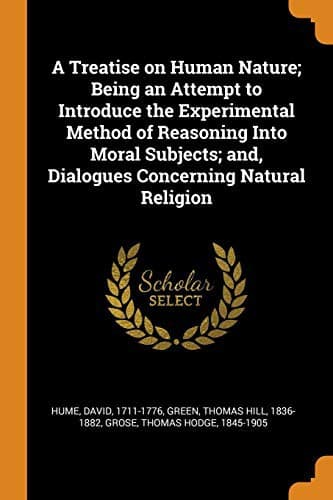
A Treatise of Human Nature: Being an Attempt to Introduce the Experimental Method Into Moral Subjects; and Dialogues Concerning Natural ReligionHume, David
PhilosophyPhilosophy
A Treatise of Human Nature: Being an Attempt to Introduce the Experimental Method Into Moral Subjects; and Dialogues Concerning Natural Religion
Hume, David
Emotions; Ethics; Knowledge, Theory of; Philosophy, English
the ‘tabula rasa’ be cognisant of itself?
Why it seems so.
10. The cover under which this difficulty was hidden from Locke,
as from popular psychologists ever since, consists in the implicit
assumption of certain ideas, either as possessed by or acting upon
the mind in the supposed primitive state, which are yet held to be
arrived at by a gradual process of comparison, abstraction, and
generalisation. This assumption, which renders the whole system
resting upon the interrogation of consciousness a paralogism, is yet
the condition of its apparent possibility. It is only as already
charged with a content which is yet (and for the individual, truly)
maintained to be the gradual acquisition of experience, that the
primitive consciousness has any answer to give to its interrogator.
Locke’s account of origin of ideas.
11. Let us consider the passage where Locke sums up his theory of
the ‘original of our ideas.’ (Book II. chap. i. sec. 23, 24.) ‘Since
there appear not to be any ideas in the mind, before the senses have
conveyed any in, I conceive that ideas in the understanding are
coeval with sensation; which is such an impression, made in some part
of the body, as produces some perception in the understanding. It is
about these impressions made on our senses by outward objects, that
the mind seems first to employ itself in such operations as we call
perception, remembering, consideration, reasoning, &c. In time the
mind comes to reflect on its own operations about the ideas got by
sensation, and thereby stores itself with a new set of ideas, which
I call ideas of reflection. These impressions that are made on our
senses by outward objects, that are extrinsical to the mind; and
its own operations, proceeding from powers intrinsical and proper
to itself, which, when reflected on by itself, become also objects
of its contemplation, are, as I have said, the original of all
knowledge.’
Its ambiguities _(a)_ In regard to sensation.
Public-domain text, read in full here on John Shaqi.
Reviews
Reviews
No reviews yet
Be the first to share your thoughts on this work.
Join the Discussion
Join the discussion
Sign in to leave a comment or review.
Sign InorCreate an account