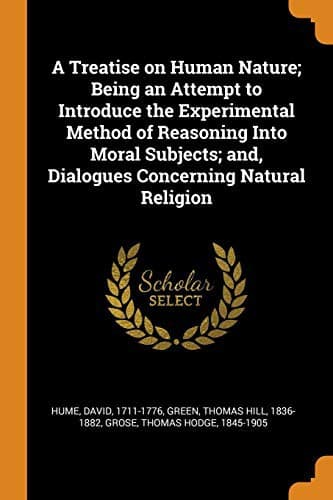
A Treatise of Human Nature: Being an Attempt to Introduce the Experimental Method Into Moral Subjects; and Dialogues Concerning Natural Religion — John Shaqi
A Treatise of Human Nature: Being an Attempt to Introduce the Experimental Method Into Moral Subjects; and Dialogues Concerning Natural ReligionHume, David
PhilosophyPhilosophy
A Treatise of Human Nature: Being an Attempt to Introduce the Experimental Method Into Moral Subjects; and Dialogues Concerning Natural Religion
Hume, David
Emotions; Ethics; Knowledge, Theory of; Philosophy, English
12. Can we from this passage elicit a distinct account of the
beginning of intelligence? In the first place it consists in an
‘idea,’ and an idea is elsewhere (Introduction, sec. 8) stated
to be ‘whatsoever is the object of the understanding, when a man
thinks.’ But the primary idea is an ‘idea of sensation.’ Does this
mean that the primary idea _is_ a sensation, or is a distinction
to be made between the sensation and the idea thereof? The passage
before us would seem to imply such a distinction. Looking merely
to it, we should probably say that by _sensation_ Locke meant ‘an
impression or motion in some part of the body;’ by the _idea of
sensation_ ‘a perception in the understanding,’ which this impression
produces. The account of perception itself gives a different result.
(Book II. chap. ix. sec. 3.) ‘Whatever impressions are made on the
outward parts, if they are not taken notice of within, there is no
perception. Fire may burn our bodies with no other effect than it
does a billet, unless the motion be continued to the brain, and
there the _sense_ of heat or _idea_ of pain be produced in the mind,
wherein consists actual _perception_.’ Here sensation is identified
at once with the idea and with perception, as opposed to the
impression on the bodily organs. [1] To confound the confusion still
farther, in a passage immediately preceding the above, ‘Perception,’
here identified with the idea of sensation, has been distinguished
from it, as ‘exercised about it.’ ‘Perception, as it is the first
faculty of the mind exercised about our ideas, so it is the first and
simplest idea we have from reflection.’ Taking Locke at his word,
then, we find the beginning of intelligence to consist in having an
idea of sensation. This idea, however, we perceive, and to perceive
is to have an idea; _i.e._ to have an idea of an idea of sensation.
But of perception again we have a simple or primitive idea. Therefore
the beginning of intelligence consists in having an idea of an idea
of an idea of sensation.
[1] Cf. Book II. chap. xix. sec. 1. ‘The _perception_, which actually
accompanies and is annexed to any impression on the body, made by
an external object, being distinct from all other modifications of
thinking, furnishes the mind with a distinct idea which we call
_sensation_; which is, as it were, the actual entrance of any idea
into the understanding by the senses.’
_(b)_ In regard to ideas of reflection.
Public-domain text, read in full here on John Shaqi.
Reviews
Reviews
No reviews yet
Be the first to share your thoughts on this work.
Join the Discussion
Join the discussion
Sign in to leave a comment or review.
Sign InorCreate an account