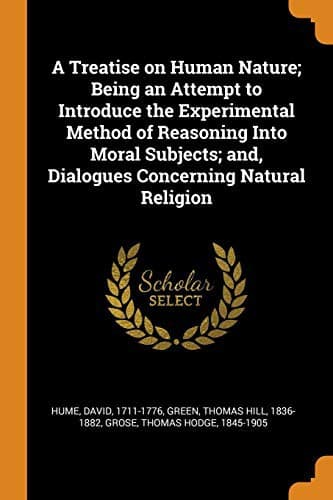
A Treatise of Human Nature: Being an Attempt to Introduce the Experimental Method Into Moral Subjects; and Dialogues Concerning Natural Religion — John Shaqi
A Treatise of Human Nature: Being an Attempt to Introduce the Experimental Method Into Moral Subjects; and Dialogues Concerning Natural ReligionHume, David
PhilosophyPhilosophy
A Treatise of Human Nature: Being an Attempt to Introduce the Experimental Method Into Moral Subjects; and Dialogues Concerning Natural Religion
Hume, David
Emotions; Ethics; Knowledge, Theory of; Philosophy, English
17. It is not difficult to show that to have a simple idea, according
to Locke’s account of it, means to have already the conception of
substance and relation, which are yet according to him ‘complex
and derived ideas,’ ‘the workmanship of the mind’ in opposition to
its original material, the result of its action in opposition to
what is given it as passive. The equivocation in terms under which
this contradiction is generally covered is that between ‘idea’
and ‘quality.’ ‘Whatever the mind perceives in itself, or is the
immediate object of perception, thought, or understanding, that
I call _idea_; and the power to produce that idea I call quality
of the subject wherein that power is. Thus a snowball having
power to produce in us the ideas of white, cold, and round, the
powers to produce these ideas in us, as they are in the snowball,
I call qualities; and as they are sensations or perceptions in
our understandings, I call them ideas; which ideas, if I speak of
sometimes as in the things themselves, I would be understood to mean
those qualities in the object which produce them in us.’ (Book II.
chap. viii. sec. 8.)
Locke’s way of interchanging ‘idea’ and ‘quality’ and its effects.
18. An equivocation is not the less so because it is announced.
It is just because Locke allows himself at his convenience to
interchange the terms ‘idea’ and ‘quality’ that his doctrine is at
once so plausible and so hollow. The essential question is whether
the ‘simple idea,’ as the original of knowledge, is on the one hand
a mere feeling, or on the other a thing or quality of a thing.
This question is the crux of empirical psychology. Adopting the
one alternative, we have to face the difficulty of the genesis of
knowledge, as an apprehension of the real, out of mere feeling;
adopting the other, we virtually endow the nascent intelligence with
the conception of substance. By playing fast and loose with ‘idea’
and ‘quality,’ Locke disguised the dilemma from himself. Here again
the metaphor of Impression did him yeoman’s service. The idea, or
‘immediate object of thought,’ being confused with the affection
of the sensitive organs, and this again being accounted for as the
result of actual impact, it was easy to represent the idea itself as
caused by the action of an outward body on the ‘mental tablet.’ Thus
Locke speaks of the ‘objects of our senses obtruding their particular
ideas on our minds, whether we will or no.’ (Book II. chap. i. sec.
25.) This sentence holds in solution an assumption and two fallacies.
The assumption (with which we have no further concern here) is the
physical theory that matter affects the sensitive organs in the way
of actual impact. Of the fallacies, one is the confusion between this
affection and the idea of which it is the occasion to the individual;
the other is the implication that this idea, as such, in its prime
simplicity, recognises itself as the result of, and refers itself as
a quality to, the matter supposed to cause it.
Public-domain text, read in full here on John Shaqi.
Reviews
Reviews
No reviews yet
Be the first to share your thoughts on this work.
Join the Discussion
Join the discussion
Sign in to leave a comment or review.
Sign InorCreate an account