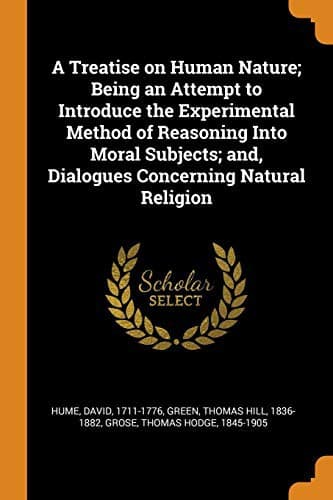
A Treatise of Human Nature: Being an Attempt to Introduce the Experimental Method Into Moral Subjects; and Dialogues Concerning Natural ReligionHume, David
PhilosophyPhilosophy
A Treatise of Human Nature: Being an Attempt to Introduce the Experimental Method Into Moral Subjects; and Dialogues Concerning Natural Religion
Hume, David
Emotions; Ethics; Knowledge, Theory of; Philosophy, English
16. The real source of these embarrassments in Locke’s theory,
it must be noted, lies in the attempt to make the individual
consciousness give an answer to its interrogator as to the beginning
of knowledge. The individual looking back on an imaginary earliest
experience pronounces himself in that experience to have been simply
sensitive and passive. But by this he means consciously sensitive
_of something_ and consciously passive _in relation to something_.
That is, he supposes the primitive experience to have involved
consciousness of a self on the one hand and of a thing on the other,
as well as of a relation between the two. In the ‘idea of sensation’
as Locke conceived it, such a consciousness is clearly implied,
notwithstanding his confusion of terms. The idea is a perception,
or consciousness _of a thing_, as opposed to a sensation proper or
affection of the bodily organs. Of the perception, again, there is
an idea, _i.e._ a consciousness by the man, in the perception, of
himself in negative relation to the thing that is his object, and
this consciousness (if we would make Locke consistent in excluding an
unperceived perception) must be taken to go along with the perceptive
act itself. No less than this indeed can be involved in any act that
is to be the beginning of knowledge at all. It is the minimum of
possible thought or intelligence, and the thinking man, looking for
this beginning in the earliest experience of the individual human
animal, must needs find it there. But this means no less than that he
is finding there already the conceptions of substance and relation.
Hence a double contradiction: firstly, a contradiction between the
primariness of self-conscious cognisance of a thing, as the beginning
of possible knowledge, on the one hand, and the primariness of
animal sensation in the history of the individual man on the other;
secondly, a contradiction between the primariness in knowledge of
the ideas of substance and relation, and the seemingly gradual
attainment of those ‘abstractions’ by the individual intellect. The
former of these contradictions is blurred by Locke in the two main
confusions which we have so far noticed: _(a)_ the confusion between
sensation proper and perception, which is covered under the phrase
‘idea of sensation;’ a phrase which, if sensation means the first act
of intelligence, is pleonastic, and if it means the ‘motion of the
outward parts continued to the brain,’ is unmeaning; and _(b)_ the
confusion between the physical affection of the brain and the act of
the self-conscious subject, covered under the equivocal metaphor of
impression. The latter contradiction, that concerning the ideas of
substance and relation, has to be further considered.
How this contradiction is disguised.
Public-domain text, read in full here on John Shaqi.
Reviews
Reviews
No reviews yet
Be the first to share your thoughts on this work.
Join the Discussion
Join the discussion
Sign in to leave a comment or review.
Sign InorCreate an account