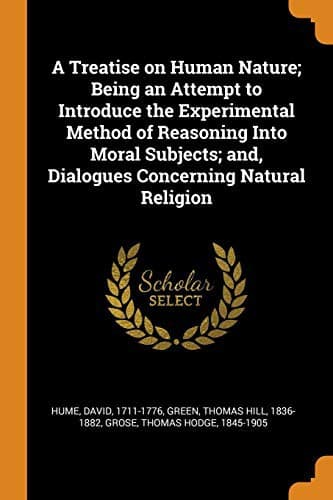
A Treatise of Human Nature: Being an Attempt to Introduce the Experimental Method Into Moral Subjects; and Dialogues Concerning Natural ReligionHume, David
PhilosophyPhilosophy
A Treatise of Human Nature: Being an Attempt to Introduce the Experimental Method Into Moral Subjects; and Dialogues Concerning Natural Religion
Hume, David
Emotions; Ethics; Knowledge, Theory of; Philosophy, English
derived from experience of identical things. But it is otherwise
if the conceptions of causation and identity are correlative--not
results of experience of which one must be formed before the
other, but co-ordinate expressions of one and the same synthetic
principle, which renders experience possible. And this is the real
state of the case. It is true, as Hume points out, that when we
want to know whether a certain sensation, precisely resembling one
that we have previously experienced, represents the same object,
we do so by asking how otherwise it can be accounted for. If no
difference appears in its antecedents or sequents, we identify
it--refer it to the same thing--as that previously experienced; for
its relations (which, since it is an event in time, take the form
of antecedence and sequence) _are_ the thing. The conceptions of
identity and of relation in the way of cause and effect are thus as
strictly correlative and inseparable as those of the thing and of
its relations. Without the conception of identity experience would
want a centre, without that of cause and effect it would want a
circumference. Without the supposition of objects which ‘existing at
one time are the same with themselves as existing at other times’--a
supposition which at last, when through acquaintance with the
endlessness of orderly change we have learnt that there is but one
object for which such identity can be claimed without qualification,
becomes the conception of nature as a uniform whole--there could
be no such comparison of the relations in which an object is now
presented with those in which it has been before presented, as
determines us to reckon it the cause or effect of another; but it is
equally true that it is only by such comparison of relations that the
identity of any particular object can be ascertained.
[1] P. 376. [Book I, part III., sec. II.]
Hume quite right in saying that we do not go _more_ beyond sense in
reasoning than in perception.
Public-domain text, read in full here on John Shaqi.
Reviews
Reviews
No reviews yet
Be the first to share your thoughts on this work.
Elsewhere in the archive
Join the Discussion
Join the discussion
Sign in to leave a comment or review.
Sign InorCreate an account