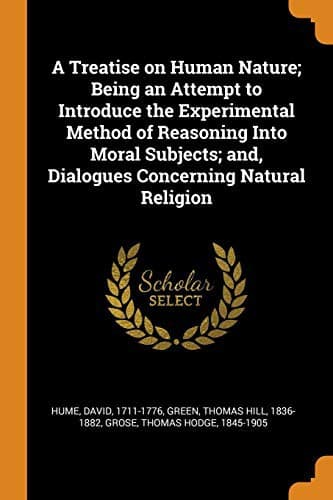
A Treatise of Human Nature: Being an Attempt to Introduce the Experimental Method Into Moral Subjects; and Dialogues Concerning Natural ReligionHume, David
PhilosophyPhilosophy
A Treatise of Human Nature: Being an Attempt to Introduce the Experimental Method Into Moral Subjects; and Dialogues Concerning Natural Religion
Hume, David
Emotions; Ethics; Knowledge, Theory of; Philosophy, English
33. In the second book of his Essay, which treats of ideas, he
makes the grand distinction between ‘the simple ideas which are all
from things themselves, and of which the mind can have no more or
other than what are suggested to it,’ and the ‘complex ideas which
are the workmanship of the mind.’ (Book II. chap. xii.) In his
account of the latter there are some curious cross-divisions, but he
finally enumerates them as ideas either of _modes_, _substances_,
or _relations_. The character of these ideas he then proceeds to
explain in the order given, one after the other, and as if each were
independent of the rest; though according to his own statement the
idea of mode presupposes that of substance, and the idea of substance
involves that of relation. ‘Modes I call such complex ideas, which,
however compounded, contain not in them the supposition of subsisting
by themselves, but are considered as dependencies on, or affections
of, substances; such are the ideas signified by the words ‘triangle,’
‘gratitude,’ ‘murder,’ &c. Of these there are two sorts. First, there
are some which are only variations or different combinations of the
same simple idea without the mixture of any other--as a dozen, or
score--which are nothing but the ideas of so many distinct units
added together; and these I call simple modes, as being contained
within the bounds of one simple idea. Secondly, there are others
compounded of simple ideas of several kinds, put together to make
one complex one; e. g. beauty, ... and these I call _mixed modes_.’
(Book II. chap. xii. secs. 4, 5.) So soon as he comes to speak more
in detail of simple modes, he falls into apparent contradiction with
his doctrine that, as complex ideas, they are the mere workmanship
of the mind. All particular sounds and colours are simple modes of
the simple ideas of sound and colour. (Book II. chap, xviii. sees. 3,
4.) Again, the ideas of figure, place, distance, as of all particular
figures, places, and distances, are simple modes of the simple idea
of space. (Book II. chap, xiii.) To maintain, however, that the ideas
of space, sound, or colour _in general_ (as simple ideas) were taken
from things themselves, while those of _particular_ spaces, sounds,
and colours (as complex ideas) were ‘made by the mind,’ was for Locke
impossible. Thus in the very next chapter after that in which he
has opposed all complex ideas, those of simple modes included, as
made by the mind to all simple ones as taken from things themselves,
he speaks of simple modes ‘either _as found in things existing_,
or as made by the mind within itself.’ (Book II. chap. xiii. sec.
1.) It was not for Locke to get over this confusion by denying the
antithesis between that which the mind ‘makes’ and that which it
‘takes from existing things’ and for the present we must leave it as
it stands. We must further note that a mode being considered ‘as an
affection of a substance,’ space must be to the particular spaces
Public-domain text, read in full here on John Shaqi.
Reviews
Reviews
No reviews yet
Be the first to share your thoughts on this work.
Join the Discussion
Join the discussion
Sign in to leave a comment or review.
Sign InorCreate an account