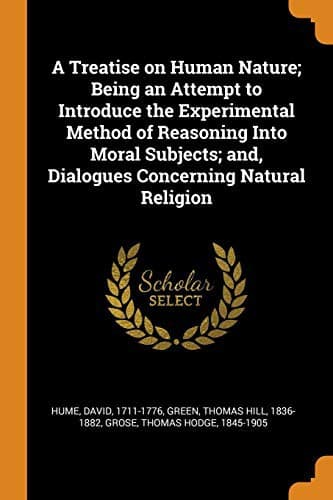
A Treatise of Human Nature: Being an Attempt to Introduce the Experimental Method Into Moral Subjects; and Dialogues Concerning Natural ReligionHume, David
PhilosophyPhilosophy
A Treatise of Human Nature: Being an Attempt to Introduce the Experimental Method Into Moral Subjects; and Dialogues Concerning Natural Religion
Hume, David
Emotions; Ethics; Knowledge, Theory of; Philosophy, English
which are its simple modes, as a substance to its modifications.
So too colour to particular colours, &c., &c. But the idea of a
substance is a complex idea ‘framed by the mind.’ Therefore the idea
of space--at any rate such an idea as we have of it when we think of
distances, places, or figures, and when else do we think of it at
all?--must be a complex and artificial idea. But according to Locke
the idea of space is emphatically a simple idea, given immediately
_both_ by sight and touch, concerning which if a man enquire, he
‘sends him to his senses.’ (Book II. chap, v.)
Such are substance and relation which must be found in every object
of knowledge.
34. These contradictions are not avoidable blunders, due to
carelessness or want of a clear head in the individual writer, ‘The
complex idea of substance’ will not be exorcised; the mind will show
its workmanship in the very elements of knowledge towards which its
relation seems most passive--in the ‘existing things’ which are
the conditions of its experience no less than in the individual’s
conscious reaction upon them. The interrogator of the individual
consciousness seeks to know that consciousness, and just for that
reason must find in it at every stage those formal conceptions,
such as substance and cause, without which there can be no object
of knowledge at all. He thus substantiates sensation, while he
thinks that he merely observes it, and calls it a sensible thing.
Sensations, thus unconsciously transformed, are for him the real, the
actually existent. Whatever is not given by immediate sense, outer or
inner, he reckons a mere ‘thing of the mind.’ The ideas of substance
and relation, then, not being given by sense, must in his eyes be
things of the mind, in distinction from, really existent things. But
speech bewrayeth him. He cannot state anything that he knows save
in terms which imply that substance and relation are in the things
known; and hence an inevitable obtrusion of ‘things of the mind’ in
the place of real existence, just where the opposition between them
is being insisted on. Again, as a man seems to observe consciousness
in himself and others, it has nothing that it has not received. It
is a blank to begin with, but passive of that which is without, and
through its passivity it becomes informed. If the ‘mind,’ then, means
this or that individual consciousness, the things of the mind must be
gradually developed from an original passivity. On the other hand,
let anyone try to know this original passive consciousness, and in
it, as in every other known object-matter, he must find these things
of the mind, substance and relations. If nature is the object, he
must find them in nature; if his own self-consciousness, he must
find them in that consciousness. But while nature knows not what is
in herself, self-consciousness, it would seem, _ex vi termini_, does
know. Therefore not merely substance and relation must be found in
Public-domain text, read in full here on John Shaqi.
Reviews
Reviews
No reviews yet
Be the first to share your thoughts on this work.
Join the Discussion
Join the discussion
Sign in to leave a comment or review.
Sign InorCreate an account