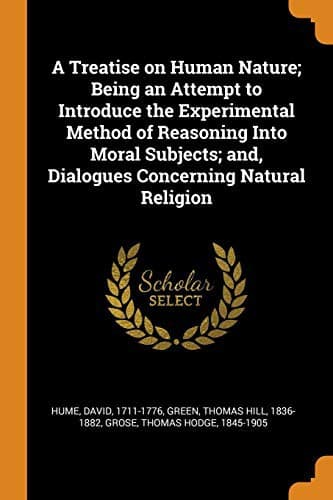
A Treatise of Human Nature: Being an Attempt to Introduce the Experimental Method Into Moral Subjects; and Dialogues Concerning Natural ReligionHume, David
PhilosophyPhilosophy
A Treatise of Human Nature: Being an Attempt to Introduce the Experimental Method Into Moral Subjects; and Dialogues Concerning Natural Religion
Hume, David
Emotions; Ethics; Knowledge, Theory of; Philosophy, English
[1] Upon a reference to the chapter on ‘complex ideas’ (Book II.
chap, xii.), it will appear that the term is used in a stricter and
a looser sense. In the looser sense it is not confined to _compound_
ideas, but in opposition to simple ones includes those of relation
and even ‘abstract general ideas.’ When Locke thinks of the _general_
idea of substance apart from the complication of accidents referred
to it, he opposes it to the complex idea, according to the stricter
sense of that term. On the other hand, when he thinks of it as ‘made
up’ of the idea of _something_ plus that of relation to qualities (as
if there could be an idea of something apart from such relation), it
seems to him to have two elements, and therefore to be complex.
The abstract idea according to Locke at once precedes and follows the
complex.
36. In the passage above quoted, our aptness to consider a
complication of simple ideas, which we notice to go constantly
together, as one simple idea, is accounted for as the result of a
presumption that they belong to one thing. This presumption is again
described in the words that ‘we accustom ourselves to suppose some
substratum, wherein they do subsist, and from which they do result;
which therefore we call substance.’ Here it is implied that the idea
of substance, _i.e._ ‘the general idea of something related as a
support to accidents,’ is one gradually formed upon observation of
the regular coincidence of certain simple ideas. In the sequel (sec.
3 of the same chapter I. xxiii.) we are told that such an idea--‘an
obscure and relative idea of substance in general--being thus made,
we come to have the ideas of particular sorts of substances by
collecting such combinations of simple ideas as are, by experience
and observation of men’s senses, taken notice of to exist together.’
Thus a _general_ idea of substance having been formed by one
gradual process, ideas of particular sorts of substances are formed
by another and later one. But then the very same ‘collection of
such combinations of simple ideas as are taken notice of to exist
together,’ which (according to sec. 3) constitutes the later process
and follows upon the formation of the _general_ idea of substance,
has been previously described as preceding and conditioning that
formation. It is the complication of simple ideas, noticed to go
constantly together, that (according to sec. 1) leads to the ‘idea
of substance in general.’ To this see-saw between the process
preceding and that following the formation of the idea in question
must be added the difficulty, that Locke’s account makes the general
idea precede the particular, which is against the whole tenor of
his doctrine of abstraction as an operation whereby ‘the mind makes
the particular ideas, received from particular objects, to become
general.’ (Book II. chap. xi. sec. 9.)
Reference of ideas to nature or God, the same as reference to
substance.
Public-domain text, read in full here on John Shaqi.
Reviews
Reviews
No reviews yet
Be the first to share your thoughts on this work.
Join the Discussion
Join the discussion
Sign in to leave a comment or review.
Sign InorCreate an account