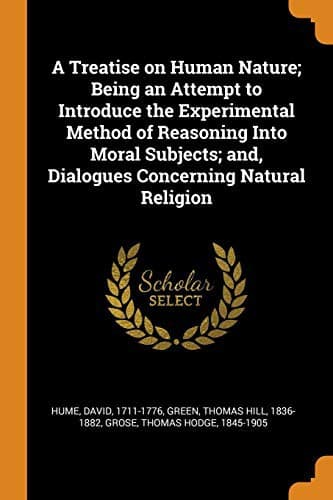
A Treatise of Human Nature: Being an Attempt to Introduce the Experimental Method Into Moral Subjects; and Dialogues Concerning Natural ReligionHume, David
PhilosophyPhilosophy
A Treatise of Human Nature: Being an Attempt to Introduce the Experimental Method Into Moral Subjects; and Dialogues Concerning Natural Religion
Hume, David
Emotions; Ethics; Knowledge, Theory of; Philosophy, English
the original consciousness, but the knowledge, the ideas, of them.
Abstract idea of substance and complex ideas of particular sorts of
substance.
35. As we follow Locke’s treatment of these ideas more in detail, we
shall find the logical see-saw, here accounted for, appearing with
scarcely a disguise. His account of the origin of the ‘complex ideas
of substances’ is as follows. ‘The mind being furnished with a great
number of the simple ideas, conveyed in by the senses, as they are
found in exterior things, or by reflection on its own operations,
takes notice also that a certain number of these simple ideas go
constantly together; which being presumed to belong to one thing,
and words being suited to common apprehensions and made use of for
quick despatch, are called, so united in one subject, by one name;
which by inadvertency we are apt afterwards to talk of and consider
as one simple idea, which indeed is a complication of many ideas
together; because, as I have said, not imagining how these simple
ideas can subsist by themselves, we accustom ourselves to suppose
some _substratum_, wherein they do subsist, and from which they do
result; which therefore we call _substance_.’ (Book II. chap, xxiii.
sec. 1.) In the controversy with Stillingfleet, which arose out of
this chapter, Locke was constrained further to distinguish (as he
certainly did not do in the original text) between the ‘ideas of
distinct substances, such as man, horse,’ and the ‘general idea of
substance.’ It is to ideas of the former sort that he must be taken
to refer in the above passage, when he speaks of them as formed by
‘complication of many ideas together,’ and these alone are _complex_
in the strict sense. The _general_ idea of substance on the other
hand, which like all general ideas (according to Locke) is made
by abstraction, means the idea of a ‘substratum which we accustom
ourselves to suppose’ as that wherein the complicated ideas ‘do
subsist, and from which they do result.’ This, however, he regards as
itself one, ‘the first and chief,’ among the ideas which make up any
of the ‘distinct substances.’ (Book II. chap. xii. sec. 6.) Nor is
he faithful to the distinction between the general and the complex.
In one passage of the first letter to Stillingfleet, he distinctly
speaks of the _general_ idea of substance as a ‘_complex_ idea made
up of the idea of something plus that of relation to qualities.’ [1]
Notwithstanding this confusion of terms, however, he no doubt had
before him what seemed a clear distinction between the ‘abstract
general idea’ of substance, as such, _i.e._ of ‘something related
as a support to accidents,’ but which does not include ideas of any
particular accidents, and the composite idea of a substance, made up
of a multitude of simple ideas plus that of the something related to
them as a support. We shall find each of these ideas, according to
Locke’s statement, presupposing the other.
Public-domain text, read in full here on John Shaqi.
Reviews
Reviews
No reviews yet
Be the first to share your thoughts on this work.
Join the Discussion
Join the discussion
Sign in to leave a comment or review.
Sign InorCreate an account