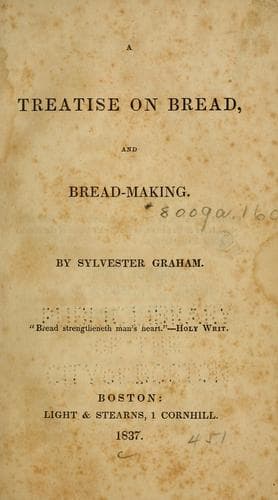
A Treatise on Bread, and Bread-makingGraham, Sylvester
History
A Treatise on Bread, and Bread-making
Graham, Sylvester
Bread
Among the materials used for making bread in our country—and, in fact,
of all the known productions of the vegetable kingdom in any country,
wheat is decidedly the best; and it is a remarkable fact, that wheat
comes nearer to man than perhaps any other plant, in its power of
becoming adapted to different climates, over a wide extent of the
earth’s surface, so that it may almost be said that wherever the human
species can flourish, there wheat can be cultivated.
“It is not certainly known,” says Prof. Thomson, “in what country wheat
was first produced. Mr. Bruce informs us that he found it growing wild
in Abyssinia; and in his opinion, that kingdom is the native country of
the plant. It would seem,” continues the Professor, “to be originally an
African plant, since it thrives best in Barbary and Egypt; and perhaps
the mountains of Abyssinia, though within the torrid zone, may not
differ much in point of climate, from the more northern plains of Egypt.
Wheat is perhaps cultivated over a greater extent of the globe than any
other plant. Excellent crops are raised as far north as Sweden, in
latitude 60°; it is cultivated in the East Indies, considerably within
the limits of the torrid zone; and in the North of Hindostan, it
constitutes a chief article in the food of the inhabitants. In India,
however, the plant seems to have deteriorated. It is always dwarfish,
and the crop is said to be less abundant than in more northern
climates.” Yet a cold climate is not most genial to the nature of this
plant. “The wheat of France is superior to that of England; the wheat of
Italy is still better than that of France; and perhaps the best of all
is raised in Barbary and Egypt.”
Excellent wheat is raised in the southern, and western, and middle
portions of the United States; and even in the northern and eastern
parts of New England, very fine crops have been produced.
But the wheat and other cultivated products of the vegetable kingdom
appropriated to the nourishment of man, like those on which our domestic
animals subsist, are too generally, in civilized life, very considerably
deteriorated, as to their wholesomeness, by the improper tillage of the
soil. I have no doubt that it is true, as stated by those who have made
the experiment, that the flour of wheat, raised on a cultivated soil
recently dressed with crude, stable manure, may readily be distinguished
by its odor, from the flour of wheat raised on a new and undepraved
soil, or from that raised on a cultivated soil which has been dressed
with properly digested manure. And if such and similar results of
improper tillage can become the sources of serious evil to the human
family, through their effects on the flesh of animals which man devours,
and on the milk and butter which he consumes, surely the immediate
effects of such a deteriorated vegetable aliment on the human system,
must be very considerable.
Public-domain text, read in full here on John Shaqi.
Reviews
Reviews
No reviews yet
Be the first to share your thoughts on this work.
Join the Discussion
Join the discussion
Sign in to leave a comment or review.
Sign InorCreate an account