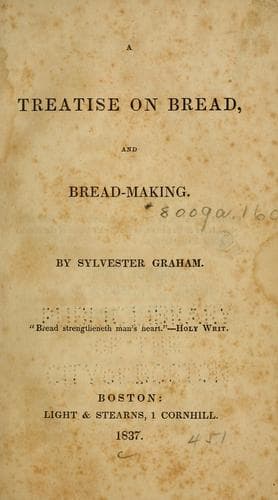
A Treatise on Bread, and Bread-makingGraham, Sylvester
History
A Treatise on Bread, and Bread-making
Graham, Sylvester
Bread
I am aware that many professional men entertain a very different opinion
on this subject, and speak of unleavened bread as being less nourishing
and less easily digested. This may be true to a limited extent, in
special cases of impaired and debilitated alimentary organs; but I am
confident that as a general fact the notion is entirely erroneous.
“The whole people of Asia,” says Dr. Cullen, “live upon unfermented
rice. The Americans, before they became acquainted with the Europeans,
employed, and for the most part, still employ their maize in the same
condition. Even in Europe, the employment of unfermented bread, and
unfermented farinaceæ in other forms, is still very considerable, and we
are ready to maintain that the morbid consequences of such a diet are
very seldom to be observed. In Scotland, nine tenths of the lower
classes of people—and that is the greater part of the whole—live upon
unfermented bread and unfermented farinaceæ in other forms, and at the
same time, I am of opinion that there are not a more healthy people
anywhere to be found. We give it to all classes and both sexes with
advantage.”
It is incontestibly true, that if two portions of the same kind of wheat
meal be taken and made, the one into unleavened and the other into
leavened bread, and both be eaten warm from the oven, the leavened bread
will prove much more oppressive and difficult to manage in the stomach
than the unleavened. But aside from the changes that are produced by the
process of fermentation, there are many other considerations why
unleavened bread of a proper quality and age, is better adapted to
sustain the alimentary organs and general constitution of man, in their
highest and best condition.
Nevertheless, it is very certain, that loaf or raised bread can be made
so nearly in accordance with the vital laws and interests of our bodies,
as scarcely to militate against them in any perceptible or appreciable
degree. And when I say this, I mean not merely its effects on the health
and longevity of a single individual, but its effects upon the human
constitution, through successive generations, for a thousand years or
more.
As a general criterion or rule, then, in regard to the character of
bread, we perceive that the most perfect loaf or raised bread, is that
which, being made of the best material, is light, and sweet, and well
baked, and still most nearly retains all the natural proportions and
properties of the original material.
MATERIAL OF BREAD.
Wheat. Extent of climate favorable to it. Injured by improper tillage.
Removal of impurities. Washing of grain. Separation of the bran from
the nutrient particles improper. Ancient Roman bread. Public bakers.
Use of bad flour. Adulterations. Poisonous agents used to disguise
them.
Public-domain text, read in full here on John Shaqi.
Reviews
Reviews
No reviews yet
Be the first to share your thoughts on this work.
Join the Discussion
Join the discussion
Sign in to leave a comment or review.
Sign InorCreate an account