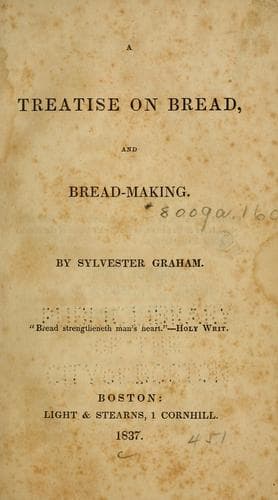
A Treatise on Bread, and Bread-making — John Shaqi
A Treatise on Bread, and Bread-makingGraham, Sylvester
History
A Treatise on Bread, and Bread-making
Graham, Sylvester
Bread
The skin or bran of the wheat is so well protected by its own oily
property, that little or no water will penetrate it, unless it be
suffered to remain in the water much longer than is necessary. Being
thinly spread out upon the sheet or table in a good drying day, it will
be sufficiently dry in a few hours for grinding. And I say again, let
any one who loves good bread, wash his grain a few times in this manner,
and he will be very reluctant to return to the use of bread made of
unwashed grain.
It would be difficult to ascertain at how early a period in the progress
of society, mankind, in the preparation of wheat for bread-making, began
to put asunder what God has joined together, and to concentrate the more
purely nutrient properties, by separating the flour from the part
commonly called the bran. The Bible speaks of fine flour or meal, as a
portion of the meat offerings of the temple, but it is not probable this
approached very near to the superfine flour of the present time.
We are informed also that the Romans, more than two thousand years ago,
had four or five different kinds of bread—one of which was made of the
purest flour, from which all the bran was separated. This was eaten only
by the rich and luxurious. A second kind, in more common use, was that
from which a portion of the bran was taken; and a third kind, which was
more generally used than any other, was that which was made of the whole
substance of the wheat. A fourth kind was made mostly of the bran, for
dogs.
But at whatever period in the history of the race, this artificial
process was commenced, certain it is that in direct violation of the
laws of constitution and relation which the Creator has established in
the nature of man, this process of mechanical analysis is, at the
present day, carried to the full extent of possibility; and the farina,
and gluten, and saccharine matter of the wheat, are almost perfectly
concentrated in the form of superfine flour. Nor is this all—these
concentrated nutrient properties of the wheat are mixed and complicated
in ways innumerable, with other concentrated substances, to pamper the
depraved appetites of man, with kinds of food which always and
inevitably tend to impair his health and to abbreviate his life.
Even the bread, which is the simplest form into which human ingenuity
tortures the flour of wheat, is, by other causes besides the
concentration I have named, too frequently rendered the instrument of
disease and death, rather than the means of life and health, to those
that eat it.
Public-domain text, read in full here on John Shaqi.
Reviews
Reviews
No reviews yet
Be the first to share your thoughts on this work.
Join the Discussion
Join the discussion
Sign in to leave a comment or review.
Sign InorCreate an account