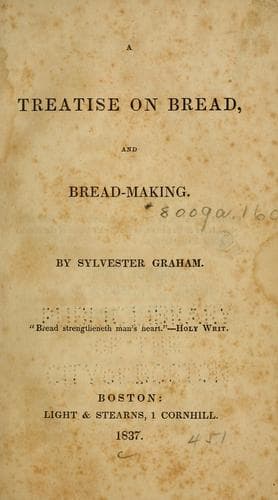
A Treatise on Bread, and Bread-makingGraham, Sylvester
History
A Treatise on Bread, and Bread-making
Graham, Sylvester
Bread
In cities and large towns, most people depend on public bakers for their
bread. And I have no doubt that public bakers, as a body, are as honest
and worthy a class of men as any in society. I have no wish to speak
evil of any one; and it is always painful to me to find myself
compelled, in fidelity to the common cause of humanity, to expose the
faults of any particular class of men, when probably every other class
in society is as deeply involved in errors which, in the sight of God,
evince, at least, an equal degree of moral turpitude.
But public bakers, like other men, who serve the public more for the
sake of securing their own emolument than for the public good, have
always had recourse to various expedients in order to increase the
lucrativeness of their business.
To secure custom and profit at the same time, they have considered it
necessary, that a given quantity of flour should be made into a loaf as
large and as white as possible, and free from any disagreeable taste,
while at the same time it retains the greatest possible weight.
From a variety of causes, the quality and price of flour have always
been very unstable. Sometimes the crops are small, or the foreign demand
for flour or the home consumption is unusually great, or the season is
unfavorable to the health of grain, and the wheat becomes diseased, or
the harvest time is unfavorable, and the wheat sprouts before it is
secured, or large quantities of flour become soured or musty, or in some
other manner damaged.
To counteract these things, and to make the most profitable use of such
flour as the market affords them, the public bakers have been led to try
various experiments with chemical agents, and there is reason to believe
that in numerous instances, they have been too successful in their
practices, for the well-being of those who have been the consumers of
their bread.
According to treatises on bread-making, which have within a few years
past appeared in European scientific journals, “alum, sulphate of zinc,
sub-carbonate of magnesia, sub-carbonate of ammonia, sulphate of copper,
and several other substances, have been used by public bakers in making
bread; and some of these substances have been employed by them to a very
great extent, and with very great success in the cause of their
cupidity. They have not only succeeded by such means, in making light
and white bread out of extremely poor flour, but they have also been
able so to disguise their adulterations, as to work in with their flour,
without being detected by the consumers, a portion of the flour of
beans, peas and potatoes—and even chalk, pipe clay and plaster of Paris,
have been employed to increase the weight and whiteness of their bread.”
Public-domain text, read in full here on John Shaqi.
Reviews
Reviews
No reviews yet
Be the first to share your thoughts on this work.
Join the Discussion
Join the discussion
Sign in to leave a comment or review.
Sign InorCreate an account