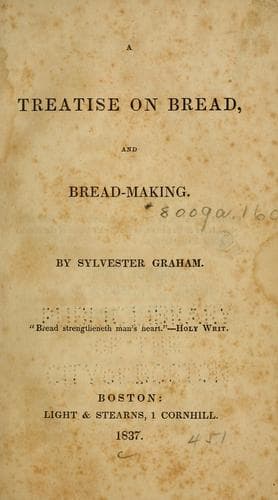
A Treatise on Bread, and Bread-makingGraham, Sylvester
History
A Treatise on Bread, and Bread-making
Graham, Sylvester
Bread
Coarse wheaten bread, then, by its adaptation to the anatomical
structure and to the physiological properties and functional powers of
our organs, serves to prevent and to remove the disorders and diseases
of our bodies, only by preventing and removing irritation and morbid
action and condition, and thereby affording the system an opportunity of
recovering its healthy and vigorous action and condition. And the
thousands of individuals in our own country of every age—of both
sexes—of all situations, conditions and circumstances, who within the
last six years have been benefited by using the coarse wheaten bread,
instead of that made of superfine flour, are living witnesses of the
virtues of that bread.
But the testimony in favor of coarse wheaten bread as an important
article in the food of man, is by no means limited to our own country
nor to modern times.
In all probability, as we have already seen, the first generations of
our species, who became acquainted with the art of making bread,
continued for many centuries to employ all the substance of the grain,
which they coarsely mashed in their rude mortars or mills. And even
since mankind began, by artificial means, to separate the bran from the
flour, and to make bread from the latter, the more close and discerning
observers among physicians and philanthropists, have perceived and
asserted, that bread made of fine flour is decidedly less wholesome than
that made of the unbolted wheat meal.
Hippocrates, styled the father of medicine, who flourished more than two
thousand years ago, and who depended far more on a correct diet and
general regimen, both for the prevention and removal of disease, than he
did on medicine, particularly commended the unbolted wheat meal bread,
“for its salutary effects upon the bowels.” It was a fact well
understood by the ancients, that this bread was much more conducive to
the general health and vigor of their bodies, and every way better
adapted to nourish and sustain them than that made of the fine flour.
And accordingly, their wrestlers and others who were trained for great
bodily power, “ate only the coarse wheaten bread, to preserve them in
their strength of limbs.” The Spartans were famous for this kind of
bread; and we learn from Pliny that the Romans, as a nation, at that
period of their history when they were the most remarkable for bodily
vigor and personal prowess and achievement, knew no other bread for
three hundred years. The warlike and powerful nations which overran the
Roman Empire, and finally spread over the greater part of Europe, used
no other kind of bread than that which was made of the whole substance
of the grain; and from the fall of the Roman Empire to the present day,
a large proportion of the inhabitants of all Europe and the greater part
of Asia, have rarely used any other kind of bread.
Public-domain text, read in full here on John Shaqi.
Reviews
Reviews
No reviews yet
Be the first to share your thoughts on this work.
Join the Discussion
Join the discussion
Sign in to leave a comment or review.
Sign InorCreate an account