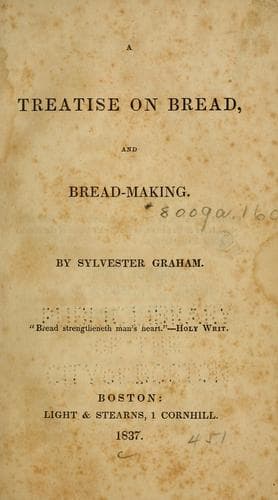
A Treatise on Bread, and Bread-makingGraham, Sylvester
History
A Treatise on Bread, and Bread-making
Graham, Sylvester
Bread
It is true, however, that the very pernicious habits of some people, who
use the coarse wheaten bread, entirely counteract the aperient effects
of the bread; and it is true that others, depending wholly on the
virtues of this bread for peristaltic action, and neglecting all
exercise, by their extreme inertness, and indolence, and overeating,
bring on a sluggishness, and debility, and constipation of the bowels,
and perhaps become severely afflicted with piles, in spite of the
natural fitness of the bread to promote regular peristaltic action, and
to prevent all these results.
A third objection is, that though the coarse wheaten bread may do very
well for those who are troubled with constipation, by mechanically
irritating and exciting the stomach and bowels, yet for that very reason
it is wholly unfit and improper for those who are afflicted with chronic
diarrhœa.
Here is still another objection founded in ignorance of the true
physiological and pathological principles which it involves. The truth
is, that the coarse wheaten bread, under a proper general regimen, is as
excellent and sure a remedy for chronic diarrhœa as for chronic
constipation.
I have seen cases of chronic diarrhœa of the most obstinate character,
and which had baffled the highest medical skill and every mode of
treatment for more than twenty years, yielding entirely under a proper
general regimen, in which this bread was the almost exclusive article of
food, and not a particle of medicine was used. And I have never known
such a mode of treatment to fail of wholly relieving diarrhœa, whether
recent or chronic; although a very great number of cases have come under
my notice.
It is fully evident, therefore, that the bran does not act on the
digestive organs as a mere mechanical irritant; for if it did, it would
always necessarily aggravate, rather than alleviate diarrhœa. Nor does
it relieve diarrhœa on the principle of a narcotic nor of a stimulant;
for the effect of these is always to give an immediate check to that
complaint; and in such a manner as to expose the system to a return of
it. But the coarse wheaten bread _seems_ to increase the disease for a
short time, at first, and then gradually restores the healthy condition
and action of the bowels.
The mucilage of wheat bran is probably one of the most soothing
substances in the vegetable kingdom, that can be applied to the mucous
membrane of the stomach and bowels.
Chronic constipation and chronic diarrhœa, both spring from the same
root. Where the constitutional vigor of the alimentary canal is very
considerable, continued irritations, resulting in debility, will produce
constipation; and these continued causes operating for some time, will
often induce such a state of debility and irritability as is attended
with diarrhœa:—and in other cases, when this constitutional vigor of the
alimentary canal is much less, diarrhœa is far more readily induced, and
rendered chronic.
Public-domain text, read in full here on John Shaqi.
Reviews
Reviews
No reviews yet
Be the first to share your thoughts on this work.
Join the Discussion
Join the discussion
Sign in to leave a comment or review.
Sign InorCreate an account