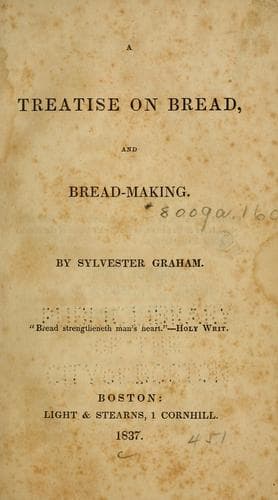
A Treatise on Bread, and Bread-makingGraham, Sylvester
History
A Treatise on Bread, and Bread-making
Graham, Sylvester
Bread
“During the war between England and France, near the close of the last
century,” says Mr. Samuel Prior, a respectable merchant of Salem, New
Jersey—“the crops of grain, and particularly wheat, were very small in
England, and the supplies from Dantzic, the Netherlands and Sweden being
cut off by the French army, and also the usual supplies from America
failing, there was a very great scarcity of wheat in England. The
British army was then very extensive, and it was exceedingly difficult
to procure provisions for it, both at home and abroad—on land and sea.
Such was the demand for the foreign army, and such the deficiency of
crops at home and supplies from abroad, that serious fears were
entertained that the army would suffer, and that the continental
enterprise of the British government would be defeated in consequence of
the scarcity of provisions; and every prudential measure by which such a
disastrous event could be prevented, was carefully considered and
proposed. William Pitt was then prime minister of state, and at his
instance, government recommended to the people generally throughout
Great Britain, to substitute potatoes and rice as far as possible, for
bread, in order to save the wheat for the foreign army. This
recommendation was promptly complied with by many of the people. But
still the scarcity was alarmingly great. In this emergency, parliament
passed a law (to take effect for two years) that the army at home should
be supplied with bread made of unbolted wheat meal, solely for the
purpose of making the wheat go as far as possible, and thus saving as
much as they could from the home consumption, for the better supply of
the army on the continent.
“Eighty thousand men were quartered in barracks in the counties of Essex
and Suffolk. A great many were also quartered throughout the towns, at
taverns, in squads of thirty or forty in a place. Throughout the whole
of Great Britain, the soldiers were supplied with this coarse bread. It
was deposited in the store-rooms with the other provisions of the army;
and on the day that it was baked, and at nine o’clock the next morning,
was distributed to the soldiers—who were at first exceedingly displeased
with the bread, and refused to eat it, often casting it from them with
great rage, and violent execrations. But after two or three weeks they
began to be much pleased with it, and preferred it to the fine flour
bread.
Public-domain text, read in full here on John Shaqi.
Reviews
Reviews
No reviews yet
Be the first to share your thoughts on this work.
Join the Discussion
Join the discussion
Sign in to leave a comment or review.
Sign InorCreate an account