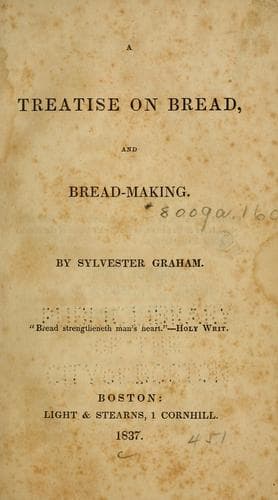
A Treatise on Bread, and Bread-makingGraham, Sylvester
History
A Treatise on Bread, and Bread-making
Graham, Sylvester
Bread
“My father,” continues Mr. P., “whom I have often heard talk these
things over, was a miller and a baker, and resided in the county of
Essex, on the border joining Suffolk, and near the barracks containing
the eighty thousand soldiers. He contracted with government, to supply
the eastern district of the county of Essex, with the kind of bread I
have mentioned: and he used always to send me with it to the
depositories on the day it was baked: and though I was then a youth, I
can still very distinctly remember the angry looks and remarks of the
soldiers, when they were first supplied with it. Indeed they often threw
their loaves at me as I passed along, and accompanied them with a volley
of curses. The result of this experiment was, that not only the wheat
was made to go much farther, but the health of the soldiers improved so
much and so manifestly, in the course of a few months, that it became a
matter of common remark among themselves, and of observation and
surprise among the officers and physicians of the army. These gentlemen
at length came out with confidence and zeal on the subject, and publicly
declared that the soldiers were never before so healthy and robust; and
that disease of every kind had almost entirely disappeared from the
army. The public papers, were for months filled with recommendations of
this bread, and the civic physicians almost universally throughout Great
Britain, pronounced it far the most healthy bread that could be eaten,
and as such, recommended it to all the people, who very extensively
followed the advice:—and the coarse wheaten bread was very generally
introduced into families—female boarding schools, and indeed all public
institutions. The nobility also generally used it; and in fact, in many
towns, it was a rare thing to meet with a piece of fine flour bread. The
physicians generally asserted that this wheaten bread was the very best
thing that could be taken into the human stomach, to promote digestion
and peristaltic action; and that it, more than anything else, would
assist the stomach in digesting other things which were less easily
digested, and therefore they recommend that a portion of it should be
eaten at every meal with other food.
Public-domain text, read in full here on John Shaqi.
Reviews
Reviews
No reviews yet
Be the first to share your thoughts on this work.
Join the Discussion
Join the discussion
Sign in to leave a comment or review.
Sign InorCreate an account