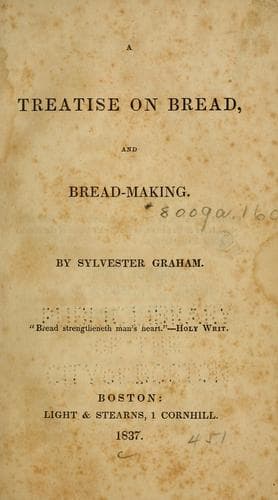
A Treatise on Bread, and Bread-makingGraham, Sylvester
History
A Treatise on Bread, and Bread-making
Graham, Sylvester
Bread
“Still, after this extensive experiment had been made with such happy
results, and after so general and full a testimony had been given in
favor of the coarse wheaten bread, when large supplies of superfine
flour came in from America, and the crops at home were abundant, and the
act of parliament in relation to the army became extinct, most of the
people who had before been accustomed to the use of fine flour bread,
now by degrees returned again to their old habits of eating fine bread.
Many of the nobility, however, continued to use the coarse bread for a
number of years afterwards. General Hanoward, Squire Western, Squire
Hanbury and others living near my father’s, continued to use the bread
for a long time, and some of them still used it when I left home and
came to America, in 1816.”
The testimony of sea captains and old whalemen is equally in favor of
wheaten bread. “I have always found,” said a very intelligent sea
captain of more than thirty years’ experience, “that the coarser my ship
bread, the healthier my crew is.”
A writer in Rees’ Cyclopædia, (article Bread) says—“The inhabitants of
Westphalia, who are a hardy and robust people, and capable of enduring
the greatest fatigues, are a living testimony to the salutary effects of
this sort of bread; and it is remarkable that they are very seldom
attacked by acute fevers, and those other diseases which are from bad
humors.”
In short, as I have already stated, the bread of a large portion of the
laboring class, or peasantry, throughout Europe, Asia and Africa, and
the islands of the ocean, whether leavened or unleavened—whether more or
less artificially prepared, is made of the whole substance of the grain
from which it is manufactured: and no one who is sufficiently
enlightened in physiological science to qualify him to judge correctly
in this matter, can doubt that bread made in the best manner from
unbolted wheat meal, is far better adapted to the anatomical structure
and physiological powers of the alimentary organs of man, than bread
made of superfine wheat flour; and consequently, the former is far more
conducive to the health and vigor and general well-being of man than the
latter.
Public-domain text, read in full here on John Shaqi.
Reviews
Reviews
No reviews yet
Be the first to share your thoughts on this work.
Join the Discussion
Join the discussion
Sign in to leave a comment or review.
Sign InorCreate an account