A Treatise on Bread, and Bread-making — John Shaqi
A Treatise on Bread, and Bread-makingGraham, Sylvester
History
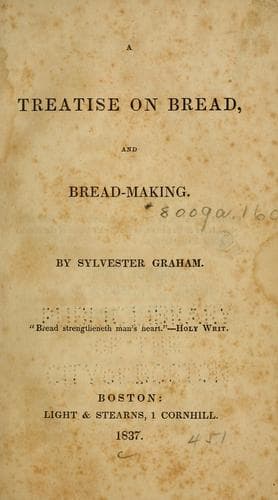
A Treatise on Bread, and Bread-making
Graham, Sylvester
Bread
According to the statement of Prof. Thomson, of Edinburgh, one pound of
good wheat meal contains ten ounces of farina or starch, three ounces of
bran, six drams of gluten and two drams of sugar;—and it is because
wheat contains such proportions of these substances that it makes the
very best loaf bread. The farina or starch is the principal nourishing
property;—the saccharine matter or sugar is also highly nutrient; but in
the process of making loaf bread, it serves mainly, by its vinous
fermentation, to produce the gas or air by which the dough is raised and
the bread made light. The gluten is likewise a very nutrient property,
but in loaf bread, it principally serves, by its cohesiveness, like gum
elastic, or India rubber, to prevent the gas or air formed by the
fermentation of the sugar, from escaping or passing off;—and the gas
being thus retained, inflates or puffs up the dough, and makes it porous
and light. The bran, with its mucilaginous and other properties, not
only adds to the nutritiousness of the bread, but eminently serves to
increase its digestibility, and to invigorate the digestive organs, and
preserve the general integrity of their functions.
The wheat which is raised in Virginia and the southern states generally,
contains a larger proportion of gluten than that which is raised in the
western part of the state of New York. Hence bakers are able to make a
larger loaf of bread out of a pound of southern flour than they can out
of a pound of western flour; and consequently some of them have
endeavored to make their customers believe that the southern flour is
the most profitable. It certainly _is_ the most profitable for the
baker; but it is not the most profitable for the consumer.
The next thing indispensably necessary to the making of good bread, is
good lively sweet yeast, or leaven, to produce what is called the
panary, or more properly, the vinous fermentation of the saccharine
matter, or sugar.
Some bread-makers will do best with one kind of yeast or leaven, and
some with another. I have generally found that people do best with those
materials to which they have been most accustomed; but I am sorry to
find so general a dependence on breweries for yeast. To say nothing of
the impure and poisonous substances which brewers employ in the
manufacture of beer, and which always affect the quality of their yeast,
I am confident that domestic yeast can be made of a far superior
quality. However light and good in other respects that bread may be
which is made with brewers yeast, I have rarely if ever seen any in
which I could not at once detect the disagreeable properties of the
yeast.
There are various ways of making domestic yeast. One of the simplest,
and perhaps the best, is the following, which was communicated to me by
one of the best bread-makers I ever saw:
Public-domain text, read in full here on John Shaqi.
Reviews
Reviews
No reviews yet
Be the first to share your thoughts on this work.
Join the Discussion
Join the discussion
Sign in to leave a comment or review.
Sign InorCreate an account